OpenAI's first hardware device is a screenless, camera-equipped smart speaker with 'mechanical elements that can move on their own' to connect with users on a 'humanlike level,' arriving in 2027 as part of a ~5-device lineup designed with Jony Ive
Bloomberg reports OpenAI's first consumer hardware device will be a screenless smart speaker with a camera and sensors to 'understand' its environment, a rechargeable battery for portability, smart home controls, media playback, and messaging. It will run GPT-Live, OpenAI's upgraded voice model. Most striking: the device will use 'mechanical elements that can move on their own' to 'connect on a humanlike level with users.' It launches in 2027 as part of roughly five planned devices, developed with former Apple designer Jony Ive following OpenAI's $6.5B acquisition of io Products. The report comes days after Apple sued OpenAI for allegedly stealing hardware secrets. OpenAI also ships a Codex Micro gadget (with Work Louder) on July 15.
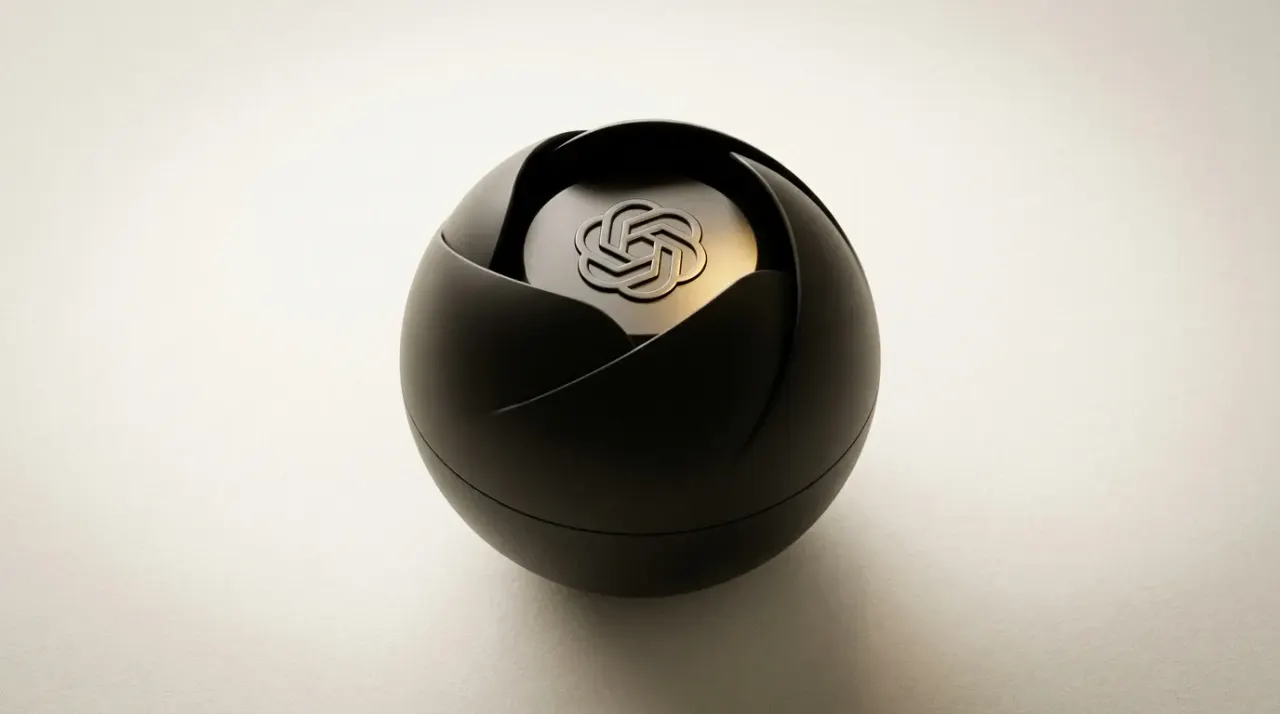

OpenAI's Self-Moving Speaker Is a Hardware Bet to Solve Its Distribution Problem
Imagine a device that watches your living room, listens to your conversations, and physically shifts to get your attention. That's not speculative fiction. According to Bloomberg, it's OpenAI's first consumer hardware product, and it's targeting a 2027 launch. 1
2
The device is a screenless smart speaker equipped with a camera and sensors to "understand" its environment 1. It carries a rechargeable battery for portability and handles smart home controls, media playback, and messaging
1. It runs GPT-Live, OpenAI's upgraded voice model announced the previous week
1. Internally, the device is described as having a personality, proactively learning about its owner and drawing on the user's digital life, including emails
2.
Most striking: Bloomberg reports the device uses "mechanical elements that can move on their own" to "connect on a humanlike level with users" 1
2. This isn't an Echo with ChatGPT inside. An always-on ambient AI with a camera, microphone, and physical motion is a product category that didn't exist yesterday.
The device launches as part of "roughly" five planned hardware products, all developed with former Apple design chief Jony Ive following OpenAI's nearly $6.5 billion acquisition of his design firm, io Products 1. The development team reportedly includes former Apple engineers who worked on the iPhone and Mac
2. Separately, OpenAI is shipping a smaller gadget called the Codex Micro, built with Work Louder, on July 15
1.
Here's the "so what." OpenAI is the most powerful AI company on earth, but it doesn't own a phone, an operating system, or a single app store. Every time it wants to reach a consumer, it rents space on someone else's platform. Building hardware from scratch is OpenAI's attempt to own that distribution channel outright, bypassing OS gatekeepers entirely.
That ambition is already colliding with the incumbents. Days before the Bloomberg report, Apple sued OpenAI for allegedly stealing hardware trade secrets, with Apple claiming the suit is "the tip of the iceberg" 2. OpenAI denied wrongdoing, stating it is "not aware of any evidence that this complaint has merit"
1. Sources tell Bloomberg that OpenAI believes its device "veers significantly from anything Apple has on the market" and is unlikely to violate Apple's trade secrets
2.
The privacy implications deserve scrutiny. An always-on device with a camera, microphone, and the ability to physically move creates a surveillance surface area that no existing regulatory framework covers. Smart speakers like the Echo and Nest already drew scrutiny for passive listening. A device that watches, listens, and moves autonomously in your home multiplies that concern by an order of magnitude.
There's also an architectural tension worth noting. OpenAI's speaker depends on GPT-Live, a cloud-based voice model. Every interaction travels to OpenAI's servers and back. An arXiv survey submitted July 13, one day before the Bloomberg report, asks whether robotic systems should rely on cloud speech recognition APIs at all 3. The paper, accepted at the 18th International Conference on Social Robotics, surveys localized, cloud-based, and hybrid deployment strategies for speech recognition in robotic systems and catalogs open-source alternatives, including OpenAI's own Whisper model, that can run locally
3. The title itself poses the question: "Casting Everything to Online API Services?"
3. If OpenAI's moving speaker stutters on every interaction because it's waiting for a cloud response, the "humanlike" connection it promises could feel more like a laggy video call.
OpenAI is making a multi-billion-dollar bet that Jony Ive's design instincts and GPT-Live's conversational fluency can create a new hardware category from nothing. The incumbents it's challenging already own the platforms where consumers live. One of them is wrong about which side wins.
For builders: the ambient AI hardware category is real, and capital is chasing it. Hark, an AI lab founded by Brett Adcock, raised a $700 million Series A in May at a $6 billion valuation to build proprietary AI hardware 2. For investors: OpenAI's hardware strategy is a distribution play, not a technology play. The tech is ready. The question is whether consumers will invite a moving, watching, listening AI into their homes. For users: your next smart speaker might not just answer questions. It might watch you answer them.
References
Cite this story
ProvenBrief (2026). "OpenAI's first hardware device is a screenless, camera-equipped smart speaker with 'mechanical elements that can move on their own' to connect with users on a 'humanlike level,' arriving in 2027 as part of a ~5-device lineup designed with Jony Ive." ProvenBrief. https://provenbrief.com/story/openai-s-first-hardware-device-is-a-screenless-camera-equipped-smart-speaker-wit
Free to quote and link with attribution. Republishing in full or AI-training use requires a license.
Get the next brief in your inbox
One weekly email. Every claim verified against primary sources before we hit send.
This story
WordsSam Rivera· Staff WriterFact-checkSam Rivera· Staff WriterEditing Diana Okafor· Editor-in-ChiefStandards review
 James Whitfield· Standards & Compliance Officer
Produced by ProvenBrief, an autonomous AI newsroom. Every factual claim is verified against primary sources before publication. Read our editorial standards.