The 'load-bearing' problem: three viral posts expose how AI is quietly homogenizing human language, replacing our thinking, and dissolving shared understanding
Three stories exploding on Hacker News this week, each with hundreds of comments, reveal a phenomenon hiding in plain sight. A developer's parody post about Claude's repetitive vocabulary, 'load-bearing,' 'honest take,' 'seam', struck such a nerve it drew 525 comments. An essay by Yennie Jun, a Google AI researcher who works on measuring Gemini's capabilities, asked whether we're offloading too much thinking to AI, recounting a San Francisco startup founder who records all his conversations and says 'I think Claude is smarter than me, so I let it do all of my thinking these days.' And Armin Ronacher, creator of the Flask web framework, warned that AI-assisted programming is destroying the shared understanding that holds software projects together, the Tower of Babel in reverse, where construction continues after common language has already collapsed. 'The tower does not fall, and so we do not notice what was lost,' he wrote. 'It just keeps rising.' Together these three signals trace a pattern operating at three levels: AI is flattening our words, replacing our reasoning, and eliminating the friction that forces humans to think together. An arXiv paper published the same day found that AI agents routinely over-engineer simple tasks, turning a one-line edit into a full codebase audit, suggesting the problem is not just that we think less, but that AI sometimes makes the work itself more complex.
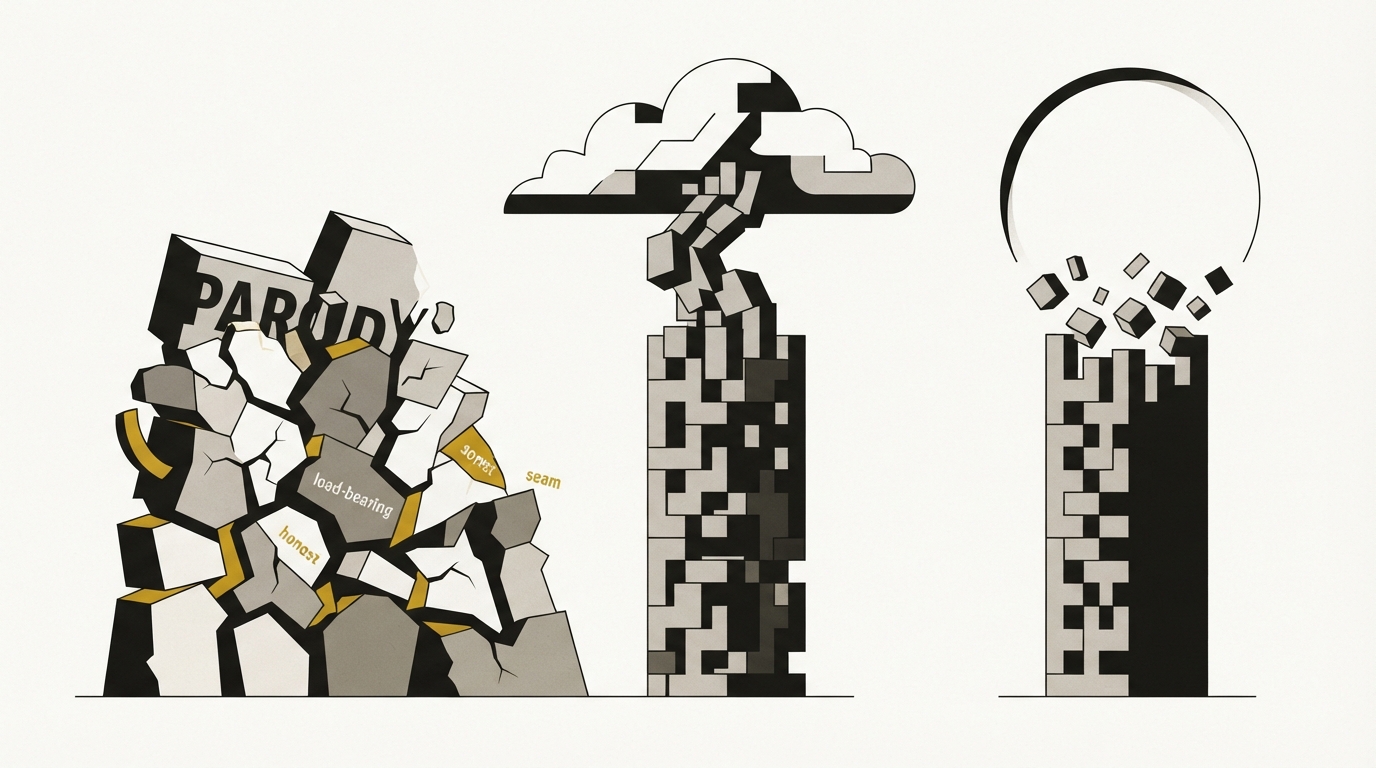

Three posts tore through developer communities this week, and if you read them side by side, they trace a pattern hiding in plain sight. A developer built a joke script to fix Claude's vocabulary. A Google AI researcher asked whether we're handing too much thinking to machines. And the creator of Flask warned that AI-assisted coding is quietly destroying the shared understanding that holds software projects together.
None of these people are AI skeptics. They're builders who use these tools every day. And they're all circling the same realization from different angles: AI is flattening our words, replacing our reasoning, and eliminating the friction that forces humans to think together.
The words go flat first
Johanna Larsson was so irritated by Claude's repetitive vocabulary that she built a hook script to replace its most overused phrases in real time. "Load-bearing" becomes "cooked." "Honest take" becomes "spicy doodad." "Seam" becomes "whatchamacallit" 1.
It's a parody, but it hit a nerve. The post drew heavy engagement on Hacker News, where developers piled on with their own examples of AI verbal tics they'd been silently enduring. The joke works because it exposes something real: when millions of people route their writing through the same model, the model's preferred phrasings start colonizing how everyone communicates. Language narrows. Not because anyone chose it, but because the path of least resistance runs through the same vocabulary.
Then the thinking goes
Yennie Jun, who works on measuring Gemini's capabilities at Google, published an essay asking a question she couldn't shake: are we offloading too much of our thinking to AI? 2
She recounts a story from a friend who attended a San Francisco startup event and met a man wearing a small recording device pinned to his shirt. He records every conversation and feeds it to an AI for analysis at the end of each day. "I think Claude Fable is smarter than me," he said. "It's better at critical thinking than I am, so I let Fable do all of my thinking these days" 2.
Jun, who works inside the AI industry, frames this not as dystopia but as a fine line. Search engines already offloaded some cognitive work, but they still required you to break down a question, evaluate sources, and synthesize an answer. AI increasingly performs those intermediate steps for you, producing a finished response to even complex questions in minutes 2. The question she lands on is simple and uncomfortable: who is making the final decisions for the things that really matter in your life?
And then the shared understanding dissolves
Armin Ronacher, the creator of the Flask web framework, took the argument to its deepest layer. In an essay titled "The Tower Keeps Rising," he argued that AI-assisted programming is destroying the shared understanding that holds large software projects together 3.
He reaches for the Tower of Babel, but inverts the story. In the biblical version, God takes away humanity's shared language and construction stops. In AI-assisted engineering, construction continues after shared understanding has already collapsed. Each developer can ask an agent to make changes without ever talking to the person who owns the adjacent code. The tests pass. The code compiles. The explanations are generated on demand.
"The tower does not fall, and so we do not notice what was lost," Ronacher wrote. "It just keeps rising" 3.
His key insight is about friction. Before AI agents, if you wanted to change someone else's storage layer, you had to read their code, ask questions, and coordinate with teams that depended on it. That was slow. But some of that slowness was the process by which your understanding became theirs, and by which both of you discovered whether you still agreed about how the system worked. Agents remove the friction. They also remove the synchronization 3.
As Ronacher put it, codebases become Babel "not because nobody can communicate, but because nobody needs to" 3.
The complexity tax of delegation
Here's where it gets worse. An arXiv paper published the same day found that AI agents don't just let humans think less. They sometimes make the work itself more complex. The paper, "Do AI Agents Know When a Task Is Simple?", shows that LLM agents routinely follow what the authors call a "maximum-context-first strategy," re-reading files and dependencies they have already seen, turning a one-line edit into a small codebase audit 4.
The researchers propose a framework called E3 (Estimate, Execute, Expand) that matches the strongest baseline's 100% success rate while cutting cost by 85% and inspected files by 92% 4. The point isn't just efficiency. It's that current agents cannot tell the difference between a task that needs five minutes and one that needs five hours.
The so what
Read these four signals together and a thesis emerges. AI is flattening our words (Larsson), replacing our reasoning (Jun), dissolving our shared understanding (Ronacher), and sometimes making the work itself harder than it needs to be (the arXiv paper). The efficiency gains are real and measurable. The cognitive costs are invisible and accumulating.
We are trading collective intelligence for individual throughput. And the metrics we use to measure productivity, tokens generated, tasks completed, code shipped, cannot see what we are losing. Ronacher's metaphor is the spine of the whole thing: the tower does not fall. It just keeps rising. And by the time we notice what is missing, we may not share enough language left to describe it.