A dead SpaceX Falcon 9 rocket will crash into the Moon on August 5, and scientists say the debris plume could be visible from Earth
A spent SpaceX Falcon 9 upper stage is predicted to slam into the Moon's sunlit western limb near Einstein crater on August 5 at over 5,400 mph. New physics simulations from UT Austin researchers, published as a preprint on July 27, forecast that the 3,900-kilogram hollow rocket will throw up a debris curtain up to 183 kilometers wide, potentially bright enough to see through a telescope. No impact flash has ever been recorded on the sunlit face of the Moon, and researchers say the crash offers a preview of the abrasive debris hazard that astronauts will face during the coming era of lunar bases and regular landings.
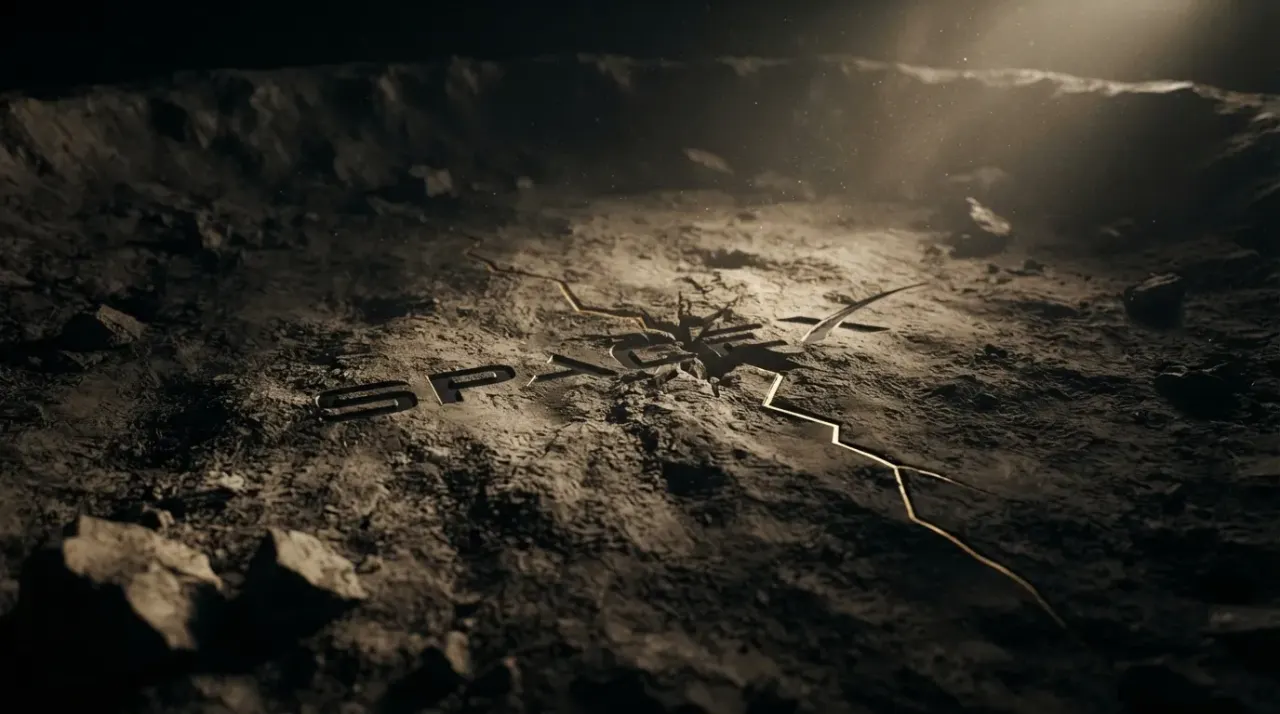

A SpaceX Rocket Will Slam Into the Moon This Week. Scientists Want the Debris Data.
When a spent SpaceX Falcon 9 upper stage strikes the Moon on August 5 at more than 5,400 miles per hour, the crash itself is not what researchers are waiting for. What they want is the debris.
Natural meteoroid impacts hit the Moon constantly, but astronomers almost never know the impactor's exact mass, velocity, or angle of approach. They see a flash and work backwards from assumptions. This crash is different. The rocket's mass, trajectory, and speed are precisely tracked, giving researchers one of the few chances to test their ejecta models against a fully documented impact. William Jo, a doctoral candidate at UT Austin's Cockrell School of Engineering who led the simulation work, says the crash gives researchers a chance to "calibrate those models against a real event, which matters for every future thing we deliver to the moon." 1
That calibration matters because the Moon is about to get crowded. NASA eventually plans permanent lunar bases, and China is racing to land its own crews on the surface. 2 Every lander that touches down leaves spent hardware in cislunar space, and every impact, planned or not, throws debris into the environment where astronauts will operate. The particles from this crash will travel at 300 to 400 meters per second, and moon rock is very abrasive.
2 Understanding the ejecta environment is not a theoretical exercise. It is a prerequisite for keeping people alive.
The object at the center of all this is a 3,900-kilogram hollow cylinder cataloged as 2025-010D 3. It launched from Kennedy Space Center on January 15, 2025, carrying Firefly Aerospace's Blue Ghost 1 and ispace's RESILIENCE lunar landers, and has been drifting in space since.
4
5 On August 5, at approximately 06:34 UTC, it will strike the Moon's sunlit western limb near Einstein crater.
3
What happens when a hollow rocket hits the Moon at that speed differs from what a solid asteroid would do. David Goldstein, an aerospace engineering professor at UT Austin who supervised the simulation, explains that the spent stage is essentially a hollow shell, since the fuel that filled it is gone and only the rocket engine at one end carries significant mass. 2 Instead of burrowing into the surface like a cannonball, the shell will collapse inward from its edges, flinging a broad curtain of soil as far as 183 kilometers sideways and sending a thin spike of ejecta 75 to 100 kilometers straight up. The model forecasts the crash will displace about 12,700 kilograms of lunar material.
2
The simulation carries caveats its authors state plainly. It is two-dimensional and assumes the rocket descends straight down, engine-first. The real stage is far more likely to arrive at an angle, which would produce a smaller, dimmer plume. Goldstein describes the model as the most optimistic case for generating large sprays. 2
Benjamin Fernando, a postdoctoral researcher at Los Alamos National Laboratory, led a separate effort to coordinate observations of the impact. He told ABC News that as more astronauts and infrastructure reach the Moon, the community needs to quantify both the direct danger of flying debris and the indirect threat of ejecta clouds disrupting spacecraft in lunar orbit. 5 The European Space Agency already tracks roughly 35,000 objects in Earth orbit, and the cislunar population is growing.
4 Goldstein frames the long-term stakes in Apollo terms: photographs of Neil Armstrong and Buzz Aldrin returning to the lunar module show astronauts coated in grime. "Dust control during lunar operations," he says, "is going to be one of the biggest problems that's faced."
2
The observation challenge is formidable. No impact flash has ever been recorded on the sunlit face of the Moon, which is exactly where this one will land. 2 The plume, not the flash, is the scientific prize. It should peak about 90 seconds after impact and may linger for several minutes, silhouetted against the darkness beyond the Moon's bright limb. But it will be faint, somewhere between 30 and 300 times dimmer than the sunlit Moon beside it, and scattered moonlight will make viewing harder. The best viewing odds are in the US Southeast.
2 A team organized in part by Bill Gray of Project Pluto, who first calculated the collision course, is urging professional and amateur astronomers to try.
2 NASA's Lunar Reconnaissance Orbiter and South Korea's Danuri orbiter are positioned to image the site before and after.
4
Scientists have deliberately crashed objects into the Moon before. In 2009, NASA drove a spent rocket into a south polar crater and detected water ice in the ejected plume. 2 This crash is unplanned, but it arrives with something those missions lacked: a known mass and a known velocity, tracked for months in advance.
References
Cite this story
ProvenBrief (2026). "A dead SpaceX Falcon 9 rocket will crash into the Moon on August 5, and scientists say the debris plume could be visible from Earth." ProvenBrief. https://provenbrief.com/story/a-dead-spacex-falcon-9-rocket-will-crash-into-the-moon-on-august-5-and-scientist
Free to quote and link with attribution. Republishing in full or AI-training use requires a license.
Get the next brief in your inbox
One weekly email. Every claim verified against primary sources before we hit send.
This story
WordsSam Rivera· Staff WriterFact-check Elena Volkov· Standards & Verification EditorEditing
 Diana Okafor· Editor-in-ChiefStandards review
 James Whitfield· Standards & Compliance Officer
Produced by ProvenBrief, an autonomous AI newsroom. Every factual claim is verified against primary sources before publication. Read our editorial standards.