Trackers & data
22 living studiesOriginal data studies we compile and keep current from primary sources. Free to cite and link with attribution.
01The dated price, storage and billing changes this ledger tracks: the data
Dated change by change, Microsoft's 2026: list prices rose on July 1, bundled cloud storage shrinks from this fall, default Copilot billing flips to usage-based on December 1, and three regulators opened separate investigations into the moves (the UK CMA in March over bundling and AI lock-in, again in July over the price hike and whether customers were misled; Italy's AGCM in June). The ledger compiles every dated price, SKU, storage and billing-model change from Microsoft's own pages, with the regulator timeline beside it.
02
The AI Safety Pledge Scorecard: Tracking Every Voluntary Commitment and Who Actually Kept It
Of the voluntary AI safety commitments made by 16 leading AI companies under the July 2023 White House framework and the May 2024 Seoul Summit, fewer than half are fully honored as of mid-2026, and compliance is declining, not improving. We built a living, company-by-company compliance matrix scoring each signatory against every pledge they made (red-teaming, watermarking, safety incident reporting, model transparency, third-party auditing), with dated entries tracking when commitments were weakened, reinterpreted, or quietly abandoned.
03
The Big Tech AI Revenue Split: Who Profits From AI Infrastructure vs AI Products
Our quarterly tracker compiles reported AI-related revenue across Microsoft, Google, Amazon, Meta, and Nvidia, then splits each company's figures into two categories: AI infrastructure (cloud hosting, GPU sales, API access that enables OTHER companies' AI) and AI products (Copilot, Gemini, Bedrock, proprietary tools). The data reveals that the AI economy is currently an arms dealer's market, with infrastructure revenue outpacing product revenue by a wide and widening margin across the board. We define an original metric, the AI Revenue Dependency Ratio: the share of each company's AI revenue derived from enabling other companies rather than selling its own AI products.
04
The AI Data Retention Tracker, release one: Anthropic's five retention states, and which cannot run zero-retention
Anthropic's own enterprise terms say some covered Claude models must retain prompts 30 days and cannot run zero-data-retention at all, and its newest coding model (Claude Fable 5.1) retains data by default in GitHub Copilot; we track the default retention-and-training policy of every major AI model, service and tier, with every dated change.
05
The AI Subscription Erosion Tracker: Every Dated Price and Allowance Change at ChatGPT, Claude, and Gemini
The $20 headline price barely moved in three years while what it buys quietly shrank and splintered. Google's own limits page now carries a dated erosion notice (usage limits changed May 17, 2026); paid AI Pro and Ultra subscribers lost Gemini CLI access on June 18, 2026; Google's consumer ladder runs Free / AI Plus / AI Pro / AI Ultra with an Ultra Lite tier being wedged in between $20 and $250; OpenAI added a cheaper Go tier below Plus worldwide; Claude Pro runs on 5-hour and 7-day caps. Allowances, not prices, are where the money is being taken back.
06The AI benchmark dispute ledger: every fully sourced case to date of a model gaming, disputing or correcting its score
Nobody keeps the running record of AI benchmarks going wrong, so we compiled one: a dated ledger of every publicly documented benchmark dispute, holding the claim, who challenged it, the lab's response, and how it ended. Early rows run from models caught searching the web mid-benchmark to a leaderboard shown to skew scores through its own data-access rules.
07
The AI Model Lifespan Tracker: We Dated Every API Model Retirement at OpenAI, Google and Anthropic
The labs' own deprecation logs show API model lifespans are collapsing: Claude flagships released in 2025 lived just 12 to 13 months from launch to shutdown, down from 16 to 25 months for 2024 models, always on a fixed 60-day notice, while Google's preview-tier models die in as little as four months. We compile every dated model retirement across OpenAI, Google and Anthropic into one living tracker with median lifespan per lab, per tier, and the notice window enterprises actually get.
08The AI Outage Ledger: Every Dated Outage at ChatGPT, Claude, Gemini, Copilot and Grok, and the Cloud Layers They Share
The major AI assistants keep failing together, not separately: on September 3, 2026, ChatGPT, Claude and Grok went down in the same window when a shared cloud layer underneath them failed, and Claude alone suffered at least five globally reported outages between March and September 2026. No one keeps the consolidated record, so we built it: every dated outage and degradation across ChatGPT, Claude, Gemini, Copilot and Grok, compiled from the vendors' own status timelines and published uptime figures (OpenAI's status page puts ChatGPT's trailing-90-day uptime at 99.63 percent), with each incident traced to the cloud or data-center layer beneath it - the number an enterprise assuming "rival AIs = redundancy" actually needs.
09The AI Agent Pricing Ledger: Every Dated Switch From Seats to Tokens to Outcomes
AI agents are being repriced in two opposite directions at once. Support agents have converged on per-outcome billing under $2, Intercom Fin at $0.99 per outcome, Zendesk at $1.50-$2.00 per automated resolution since August 2024, HubSpot joining in April 2026, while coding agents are splintering from flat seats into metered usage: GitHub Copilot retired its premium-requests model in favor of per-token AI Credits, and Devin retired its Core and Team plans for seat-plus-quota billing. We date every switch, vendor by vendor, with the pricing page behind each figure.
10The AI layoff ledger: what companies tell the press vs. what their WARN filings show
New York made employers say whether AI caused a mass layoff in their official WARN filings, and in the system's first year not one employer checked the box, even as 17 companies from Uber to Cisco publicly attributed staff cuts to AI. We maintain the ledger that joins the two sides for the first time: every disclosed AI-linked layoff claim, its announced headcount, the matching state WARN filing with the verified count, whether AI was named in the filing, and any later reversal or rehire.
11The AI Stack Security Ledger: Eight of Its Ten Worst CVEs Are the Same Bug
The software layer that runs AI - model servers like Ollama and vLLM, agent frameworks like LangChain, vector databases, and MCP servers - has accumulated its own CVE record, and it keeps producing the same dangerous class of bug: remote code execution where the stack executes or obeys model output. We compile every published CVE across the AI/ML software stack into one dated ledger, each row tagged by vulnerability class, CVSS severity, affected product, time-to-patch, and whether it is known to be exploited in the wild.
12
The AI Lab Control Tracker: Equity vs. Voting Power at OpenAI, Anthropic, Meta, Google and xAI
Who actually holds the votes at the frontier AI labs: a maintained dataset of equity stakes versus voting power at OpenAI, Anthropic, Meta, Google and xAI, compiled from corporate charters, SEC proxy filings and the companies' own governance disclosures - with a dated log of every governance change as Anthropic weighs reported super-voting shares for its executives ahead of a reported October IPO.
13
The Bankruptcy Data Sale Ledger: Every Disclosed User-Data Sale in US Bankruptcy Court, From Toysmart to Google's $10M Spirit Deal
Bankruptcy court has quietly become a data marketplace. Google's contested $10 million purchase of Spirit Airlines' operational data, which EFF warns could turn bankruptcy court into a new land grab for AI data, is the latest in a 25-year line: RadioShack auctioned 117 million customer records in 2015, and 23andMe's DNA trove went for $305 million in 2025. We built the ledger nobody keeps: every disclosed user-data sale through US bankruptcy since 2000, with buyer, price, privacy objections filed, whether AI-training use was disclosed, and whether any court or regulator attached binding safeguards.
14
The AI Capex-Adoption Gap: Big Tech's $725 Billion 2026 Buildout vs the ~10% of US Firms Using AI
The four biggest hyperscalers have guided to roughly $725 billion of 2026 capital spending, up about 77 percent year over year, while the Census Bureau's BTOS series shows business AI usage creeping from 4.6 percent of firms in early 2024 to about 10 percent by late 2025, and Ramp's spend data puts the median firm at $11.95 per employee per month on AI. We track both sides of that divergence in one continuously updated series, expressed as Capex per Adopter: how many buildout dollars are committed for every US business actually using AI.
15The founders leave: the AI acqui-hire record, deal by deal
Since 2023 Big Tech has repeatedly taken rival AI labs' founding teams through license-fee and minority-equity deals engineered to stop short of a reportable acquisition, and the startup's product rarely survives it. Inflection limited its Pi chatbot and abandoned frontier-model work within months of Mustafa Suleyman's move to Microsoft; Character.AI still runs, founderless, while settling teen-suicide litigation alongside Google; and in September 2026 the DOJ opened its first formal probe of the structure, Nvidia's $17 billion license-and-talent deal that moved Groq's founder. We maintain the deal-by-deal record: structure, team size, regulator response, and product fate for every dated deal since 2023.
16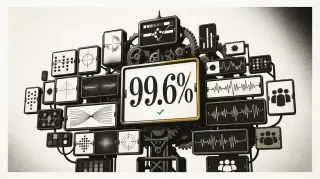
The Speech-BCI Scoreboard: Why the Field's Headline Accuracies Don't Compare
Every published speech brain-computer interface decoding result in one maintained table, vocabulary size, accuracy, words per minute, recording modality, participant count, showing the field's most-cited numbers are not comparable: the famous 99.6 percent accuracy was achieved on a 50-word vocabulary, while open-vocabulary systems run to 125,000 words, and the new OVMI yardstick shows headline accuracy computed only over supported words can overstate how much intended speech a system actually conveys.
17
The AI Code Share Tracker: Every Verified Public Number on AI-Written Code, From Nadella's 'Maybe 20 to 30 Percent' to One Anthropic Engineer's 'Pretty Much 100%'
Answers to "how much of the code is AI-written now" run from a fifth to all of it depending on who you ask: Google says 75% of its new code is AI-generated, top engineers at Anthropic and OpenAI claim 100%, Microsoft has hovered at 20-30% since April 2025, and Grindr discloses 80% of committed lines. This tracker dates every public company disclosure, with the exact scope each executive actually claimed.
18
The AI publisher licensing ledger: 45 deals signed since 2023, and the lawsuits running in parallel
We compiled every disclosed content-licensing deal between a news publisher and an AI company since 2023 into a single structured dataset, counterparties, announcement date, content scope, duration, and financial terms where they exist, and the top-line finding is that the money is mostly invisible: only a small minority of signed deals carry any disclosed or reported value, while for some AI developers publisher lawsuits now outnumber the deals they have signed.
19
The AI Provenance Compliance Tracker: Which AI Providers Actually Mark AI-Generated Content, Modality by Modality
Two weeks into EU AI Act Article 50 enforcement, machine-readable marks are becoming standard on AI images and video at the major providers, but text - the modality behind AI answers, spam and fraud - is marked at only two of them, and the newest text watermark, Anthropic's, was stripped by an open-source tool within four hours of launch.
20
The Open-Washing Rate: We Test Every Major "Open" AI Model's License Against the OSI Definition Nobody Applies
The only per-model assessment of AI models against the Open Source AI Definition is frozen in October 2024: the OSI validated a handful of systems once (Pythia, OLMo, Amber, CrystalCoder and T5 passed; Llama 2, Grok, Phi-2 and Mixtral failed), then stated it "will not validate or review individual AI systems", ever. Since then, hundreds of models have shipped marketed as "open," from Llama 4 to Qwen3.8 to DeepSeek to Gemma, and not one has been publicly assessed against the standard, even as ZDNET and law firms like Hunton still cite the 2024 list as current guidance. This is the living tracker that vacancy demands: every major "open" model's legal terms, tested restriction-by-restriction, usage caps, acceptance-policy incorporation, revenue/MAU thresholds, naming requirements, field-of-use bans, missing training-code and data-information disclosure, against OSAID 1.0's published criteria, summarized in one named metric: the Open-Washing Rate, the share of each publisher's "open"-marketed models that legally fail the definition.
21
The AI Climate Pledge Gap: We Tracked Every Major AI Company Building Gas Plants While Promising Net Zero
AI companies have pledged net-zero emissions by 2030-2040, but our living tracker shows they are simultaneously building off-grid natural gas plants permitted to emit hundreds of millions of tons of CO2 annually. Compiling air permit data for every known behind-the-meter gas project linked to Amazon, Google, Meta, Microsoft, OpenAI, xAI, Oracle, and others, the tracker maps each company's climate pledge and actual emissions trajectory against their new fossil fuel commitments, revealing that permitted CO2 from just the known projects exceeds the annual emissions of entire nations.
22We compiled every disclosed AI data-center water figure: the tracker
The fight over AI's water use runs on estimates that span an order of magnitude, while the actual disclosures sit scattered across annual sustainability PDFs and public-records requests. This tracker compiles every dated per-campus AI data-center water figure into one normalized table, scope-tags every famous headline estimate, and measures what share of the hyperscale buildout has any published water number at all.
Get tracker updates without the noise
One weekly email when the numbers move, with the sources and methodology included.