DEFCON 34 badges double as the world's first fully inspectable open-source security chip
Hacker legend Andrew "bunnie" Huang built a custom open-source microcontroller for DEFCON 34's conference badges, and 27,000 of them are about to become the first major deployment of a chip designed to be trusted down to the transistor. The Baochip-1x uses RISC-V architecture and infrared-transparent packaging that lets anyone visually inspect the silicon against the published design, closing a supply-chain trust gap that conventional black-box chips leave wide open. Each badge's core module detaches to serve as a FIDO security key, password manager, and one-time password generator. Huang published the chip's operating system, firmware, processor core, and cryptographic engines on GitHub, though some manufacturing details tied to TSMC's 22nm process remain proprietary.
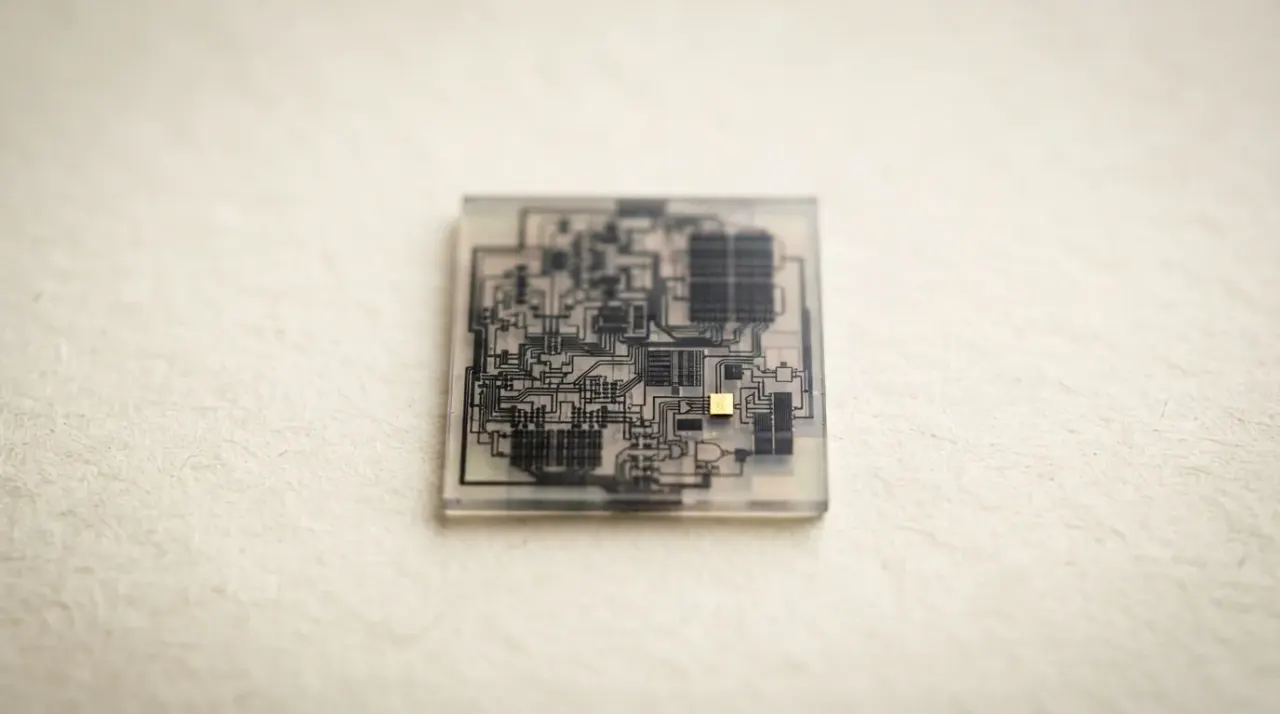

DEFCON 34 Badges Ship With a Chip You Can Actually Audit
Andrew "bunnie" Huang has spent three years trying to solve a problem that every hardware engineer knows about and almost none can fix: how do you trust a chip you did not manufacture? 1
This week, 27,000 DEFCON attendees will carry his answer in their pockets. The conference badges for DEFCON 34 contain the Baochip-1x, a microcontroller built on the open RISC-V instruction set and packaged so that anyone can shine infrared light through the back of the silicon and visually compare what they see against the published design. 1 The chip's operating system, firmware, processor core, cryptographic engines, and input-output system are all published on GitHub under the CERN-OHL-W-2.0 hardware license.
1
2
Huang calls it "probably the world's first open source security token that you can fully inspect all the way down to the bootloader [and] transistors." 1
Here is why that matters. Every conventional chip ships in an opaque plastic package. Even chips with fully open designs and published code are sealed inside that black box once they leave the foundry. There is no way to confirm that the physical silicon matches the design you audited on paper. A foundry or a supply-chain intermediary could insert a hidden block of memory, a backdoor triggered by a specific register sequence, and nobody downstream would know. 1
Huang has written in detail about how this attack works in practice. Inserting a few kilobytes of hidden RAM into a chip the size of the Baochip-1x would not affect the die size, and its impact on power consumption would be indistinguishable from normal manufacturing tolerances. The hidden memory could be gated behind a "secret knock" register that only activates when challenged with the correct sequence of words, making it practically impossible to discover through brute-force address scanning. 3
Infrared imaging closes that gap. At the 22-nanometer process node the Baochip uses, IR light passes through the back of the silicon and reveals the internal structures. You cannot resolve individual bit cells, but you can count the SRAM macros and confirm they match the number in the source code. Any extra memory block a manufacturer slipped in would be visible, even with entry-level home inspection equipment. 3
1 Huang plans to demonstrate the technique live at the conference, letting attendees inspect the chip under infrared light themselves.
1
The Baochip's path to mass production started three years ago, when a company called Crossbar approached Huang about building a new open source secure chip. Huang agreed to help on one condition: he could place his CPU design on the same silicon wafer as Crossbar's, sharing a single manufacturing run. The Crossbar version of the resulting chip uses a proprietary ARM core. Huang's version uses an open-source RISC-V core, built on the VexRiscv implementation, with the Crossbar processor disabled. 1
2
Not everything is open. Low-level physical design and manufacturing details tied to TSMC's 22-nanometer fabrication process remain proprietary. Huang describes the result as sitting "very, very far beyond any [other] security-oriented chip" on the spectrum of openness, without claiming it is fully open. 1
DEFCON founder Jeff Moss connected the project to this year's conference theme, which DEFCON defines as "agency": the technologies and choices that increase self-determination. 1 He also required that the badges have a life beyond the conference. Each badge's core module detaches and works as a FIDO hardware security token, supports time-based one-time passwords, and can function as a password manager. The module includes a camera, but it is very low resolution and nearsighted by design: it can scan QR codes to register the device with authentication systems, and by default processes only black-and-white data with no photo storage, consistent with DEFCON's ban on surreptitious photography.
1
The 27,000 badges represent the Baochip's first major distribution, moving it beyond a small development release into the hands of one of the most security-savvy audiences on the planet. 1
The proof-of-concept here is not the badge. It is the demonstration that hardware transparency at this depth is manufacturable and deployable at scale. The supply-chain trust problem, the gap between auditing a design and trusting the physical chip that arrives from a fab, has had theoretical answers for years. The Baochip-1x is a working one, shipping now, with open-source design files anyone can download and infrared inspection techniques Huang has documented for anyone to replicate.
That is the signal. A proof-of-existence for trustworthy silicon, arriving 27,000 units at a time.
References
Cite this story
ProvenBrief (2026). "DEFCON 34 badges double as the world's first fully inspectable open-source security chip." ProvenBrief. https://provenbrief.com/story/defcon-34-badges-double-as-the-world-s-first-fully-inspectable-open-source-secur
Free to quote and link with attribution. Republishing in full or AI-training use requires a license.
Get the next brief in your inbox
One weekly email. Every claim verified against primary sources before we hit send.
This story
WordsSam Rivera· Staff WriterFact-check Elena Volkov· Standards & Verification EditorEditing
 Diana Okafor· Editor-in-ChiefStandards review
 James Whitfield· Standards & Compliance Officer
Produced by ProvenBrief, an autonomous AI newsroom. Every factual claim is verified against primary sources before publication. Read our editorial standards.