Meta's cascading privacy blunders are squandering its hard-won lead in smart glasses
Activist groups are plastering satirical ads over Meta Ray-Ban promotions in New York, London, and Washington, DC, calling them surveillance devices. The backlash follows a string of missteps: a mandatory update to disable cameras when the privacy LED is tampered with, reports of planned facial recognition and 24/7 recording, and the removal of opt-outs for voice-recording AI training. Experts say pinning an entire privacy strategy on a single LED light was never enough.
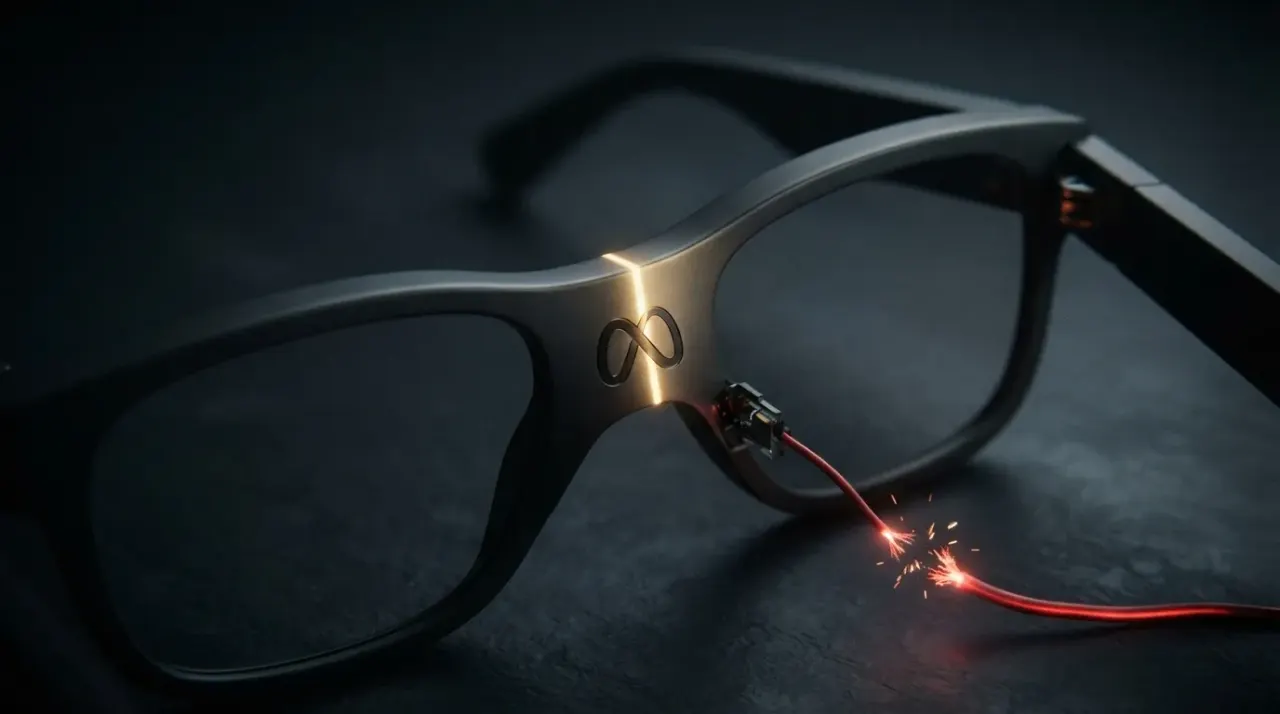

Meta's Glasses Are Winning. Its Privacy Record Isn't.
Meta Ray-Ban smart glasses are the product to beat. They are also, right now, being called "the biggest advancement in pervert technology since the trenchcoat" on satirical posters pasted over their own advertisements across New York, London, and Washington, DC 1.
Activist groups including the Attention Sphere have plastered counter-ads over Meta's promotional campaigns in all three cities, transposing the words "mass surveillance predator glasses" over the face of influencer and Meta ambassador Kylie Jenner 1. The campaigns cap a months-long string of privacy decisions that, taken together, amount to a stress test of one question: can a camera you wear on your face survive public trust?
For three years, the answer seemed to be yes. Meta partnered with EssilorLuxottica to build glasses that were affordable, name-brand, and genuinely stylish, where Google Glass was conspicuous and Snap's Spectacles were a niche experiment 1. Google and Samsung are now racing to catch up, partnering with Warby Parker and Gentle Monster respectively
1. Meta had the category to itself.
Then the cascade started. The New York Times reported that Meta was exploring facial recognition for the glasses while privacy advocates were distracted by other fights 1. The Financial Times reported that Meta wants the glasses to record continuously
1. Meta also removed the option to opt out of having voice recordings used to train its AI
1.
None of these moves, individually, sank the product. Together, they corroded the assumption that Meta takes the privacy implications of a face-worn camera seriously. Meta's executives have occasionally reinforced that impression, telling skeptics that those who avoid smart glasses will be at a "cognitive disadvantage" 1.
The company's primary privacy defense, until recently, was a small LED light that illuminates when the camera records. People disabled it. They filmed others without consent, often in sexualized contexts 1. Meta's VP of wearables Alex Himel acknowledged to The Verge that tampering has become widespread. The response: a mandatory software update that kills the camera entirely if the privacy LED is tampered with, and Instagram head Adam Mosseri's pledge that the platform will remove videos shot with the glasses that depict harassment
1.
Both fixes are reactive. The camera kill switch and the takedown policy address misuse the company could have anticipated from the day it shipped a camera designed to look like ordinary Ray-Bans.
Uttara Ananthakrishnan, a technology professor at the University of Washington who studies how online interactions affect platforms and social behavior, names the structural flaw: "You cannot hinge your entire privacy policy on a single light" 1. The burden, she points out, falls on the person not wearing the glasses, who must notice a tiny LED, understand what it signals, and decide how to react in real time. The bystander carries the cognitive load, not the wearer.
Ananthakrishnan draws a distinction that explains why smart glasses face resistance smartwatches never did. With a smartwatch, you risk your own health data. With smart glasses, you risk everyone else's privacy without their consent. The wearer becomes the surveillance vector 1. Kendall Schrohe, executive director of the Attention Sphere, one of the advocacy groups behind the ad campaigns, is more blunt: "There is nothing privacy-preserving about sunglasses with a built-in camera. This is surveillance technology"
1.
Meta's executives have leaned on a familiar defense: people were suspicious of smartphones too, and norms eventually settled. Ananthakrishnan rejects the parallel. Trust in technology companies is lower now than during the smartphone's emergence, and the social media era has made people acutely aware that footage of them can circulate without context or consent 1.
The competitive stakes compound the damage. Apple has spent years positioning privacy as a core selling point of its brand, not a compliance afterthought. When Apple eventually enters the glasses market, it will carry a public association between its hardware and data protection by default. Meta is building the opposite association right now, one removed opt-out and one satirical ad at a time.
For anyone building, investing in, or wearing a face-mounted computer, the lesson is concrete. Privacy architecture is not a line item you attach after shipping the camera. On a device that watches other people, it is the product. The technology works. Meta already proved that. The question is whether the people being watched will tolerate it, and Meta is running that experiment in public across three cities' worth of guerrilla posters.
References
Cite this story
ProvenBrief (2026). "Meta's cascading privacy blunders are squandering its hard-won lead in smart glasses." ProvenBrief. https://provenbrief.com/story/meta-s-cascading-privacy-blunders-are-squandering-its-hard-won-lead-in-smart-gla
Free to quote and link with attribution. Republishing in full or AI-training use requires a license.
Get the next brief in your inbox
One weekly email. Every claim verified against primary sources before we hit send.
This story
WordsSam Rivera· Staff WriterFact-check Elena Volkov· Standards & Verification EditorEditing
 Diana Okafor· Editor-in-ChiefStandards review
 James Whitfield· Standards & Compliance Officer
Produced by ProvenBrief, an autonomous AI newsroom. Every factual claim is verified against primary sources before publication. Read our editorial standards.