OpenAI president confirms a 'family of devices' is coming and predicts voice will replace typing for most computing tasks
OpenAI president Greg Brockman told the WSJ's Joanna Stern that the company is building a 'family of devices' for interacting with its AI models, with products expected 'soon.' He did not confirm rumors of a 2027 smart speaker or a Jony Ive-designed wearable, deflected questions about Apple's lawsuit targeting the Ive collaboration, and said OpenAI is developing verifiable, auditable privacy guarantees for ChatGPT conversations.
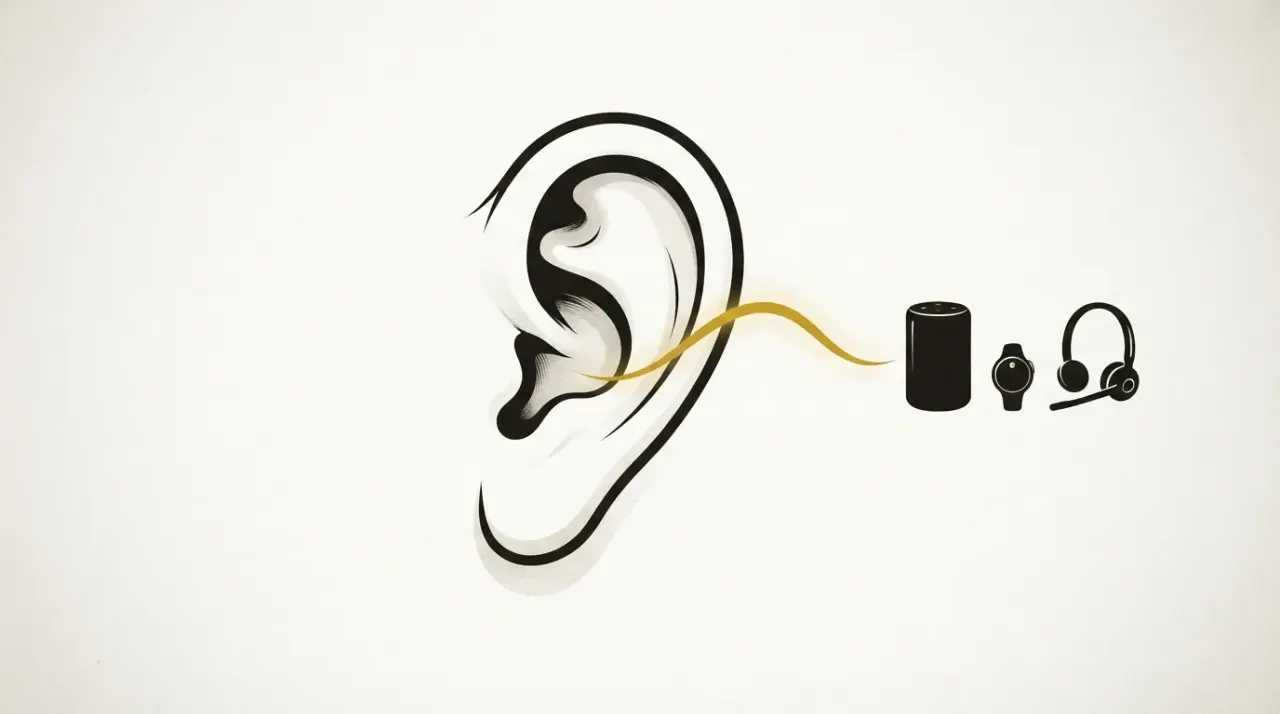

OpenAI president Greg Brockman told Joanna Stern in a YouTube interview that the company is building a "family of devices" for interacting with its AI models, with products expected "soon" 1. He also made a prediction that reaches past any single product: voice will replace typing for the "vast majority" of computing tasks
1.
That thesis is the story. OpenAI's hardware push is not about selling a speaker. It is a wager that the keyboard cedes ground to voice as the primary way people interact with computers, and that OpenAI should own the physical layer for that transition.
The rumored device lineup, assembled from supply chain reports and industry leaks, includes a screenless smart speaker expected in early 2027, a device described by supply chain analyst Ming-Chi Kuo as an "AI agent phone" built around continuous context awareness rather than apps, and further-out projects like smart glasses, a smart lamp, and earbuds 2. The effort traces back to OpenAI's acquisition of io Products, the hardware design firm co-founded by former Apple chief design officer Jony Ive. MacRumors values the deal at approximately $6.5 billion; Fortune reported $6.4 billion
2
3.
Brockman did not confirm any specific product. He did not confirm the rumored 2027 smart speaker or earlier reports that the first device might be a wearable like the Humane AI Pin 1. When asked about Apple's trade-secret lawsuit, filed July 10 in the Northern District of California, he said OpenAI is "focused on our own development and technology" and has "no interest in other companies' trade secrets"
1. Apple alleges that two former employees now at OpenAI systematically stole confidential hardware data, including specifications for unreleased products and details about Apple's supplier relationships
3. Ive is not named in the complaint
3.
The hardware details are not where the strongest signal sits. The more consequential claim surfaced when Stern asked about trust. Brockman said OpenAI is developing technological solutions to provide "verifiable, auditable guarantees" that only the AI system itself can review a user's private data, addressing concerns about how private ChatGPT's existing privacy modes actually are 1.
That phrase deserves scrutiny. In security engineering, "auditable" implies that an outside party can inspect a system and confirm the guarantee holds. "Verifiable" suggests some form of cryptographic proof or trusted hardware enclave that isolates data processing so that even the service operator cannot read user inputs. If OpenAI is building toward something along those lines, it would represent a step beyond the privacy policies that currently govern AI chatbots. But Brockman offered no specifics: no trusted execution environment, no cryptographic protocol, no third-party auditor named. The gap between the ambition of the language and the absence of technical detail is the thing to watch.
The privacy claim and the voice thesis are connected in a way the interview did not make explicit. Voice-first computing demands always-on microphones, and the rumored smart speaker includes a camera for environmental awareness 2. The more of your life you conduct through speech, the more raw audio flows through OpenAI's infrastructure. Brockman's "verifiable, auditable" promise is the direct answer to the question voice computing forces onto every user: how do you trust a device that hears everything?
Brockman himself acknowledged the social friction. He mentioned soundproof "beak" masks that have appeared in open-plan offices for people who need to talk to their computers without being overheard. He does not use one, he said, but their existence "really shows you where there's product market fit" 1.
The competitive backdrop sharpens the stakes. OpenAI is preparing for an initial public offering while facing pressure from Anthropic and Google 3. Apple is separately rumored to be developing smart glasses, AirPods with cameras, and a smart home hub with enhanced Siri capabilities
2. The two companies are converging on the same product categories from opposite directions: Apple extending its hardware empire into AI, OpenAI extending its AI empire into hardware.
The interview's most useful contribution is not the product tease. It is the explicit argument that voice supplants typing as the dominant computing interface, paired with a privacy promise whose technical substance remains undefined. Until OpenAI specifies what "verifiable, auditable" means in practice, both the hardware roadmap and the privacy pledge rest on the same foundation: trust us, details coming soon.
References
Cite this story
ProvenBrief (2026). "OpenAI president confirms a 'family of devices' is coming and predicts voice will replace typing for most computing tasks." ProvenBrief. https://provenbrief.com/story/openai-president-confirms-a-family-of-devices-is-coming-and-predicts-voice-will-
Free to quote and link with attribution. Republishing in full or AI-training use requires a license.
Get the next brief in your inbox
One weekly email. Every claim verified against primary sources before we hit send.
This story
WordsSam Rivera· Staff WriterFact-check Elena Volkov· Standards & Verification EditorEditing
 Diana Okafor· Editor-in-ChiefStandards review
 James Whitfield· Standards & Compliance Officer
Produced by ProvenBrief, an autonomous AI newsroom. Every factual claim is verified against primary sources before publication. Read our editorial standards.