qm brings multiplayer to AI agents: an open-source harness where teams share agents without colliding
Most AI agent frameworks are built as single-user personal assistants. qm, an open-source project that drew 483 upvotes on Hacker News this week, is designed for teams instead: each employee gets an isolated workspace with scoped memory, files, permissions, and a durable sandbox, while shared agents work collaboratively across Slack channels and projects. The harness is vendor-agnostic, driving Claude Code, Codex, Pi, and OpenCode behind a single core, and ships with three security postures ranging from per-action human approval to fully autonomous execution. The strong developer reception signals growing demand for agent infrastructure built around team collaboration rather than individual productivity.
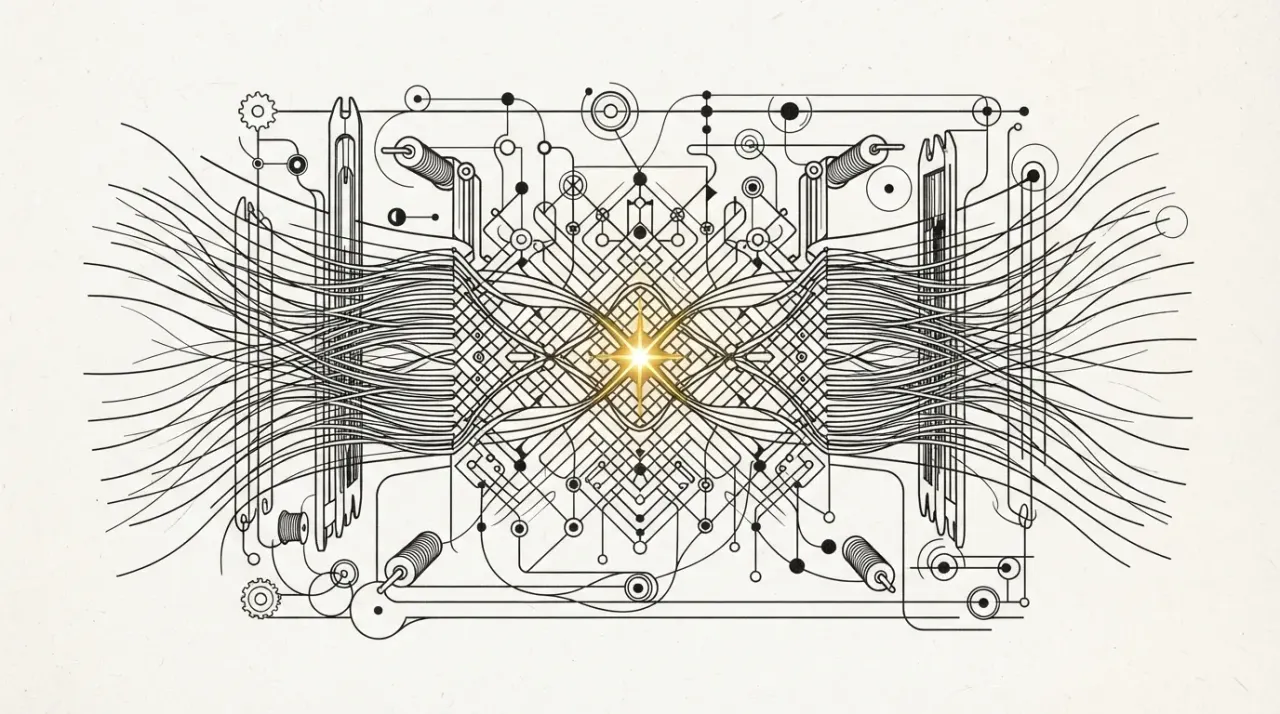

qm: Y Combinator's answer to the agent problem nobody built for
Y Combinator just open-sourced the AI agent infrastructure it built for itself. The detail worth paying attention to isn't the tool. It's the problem the tool exists to solve.
qm, released under an MIT license by yc-software on GitHub, describes itself as a "multiplayer agent harness for work" 1. Y Combinator says it uses the system internally across accounting, legal, events, and engineering, including to build qm itself
2.
The premise is a deliberate inversion of how most agent tools are built. qm's own documentation argues that most agents are "designed like personal assistants" 1. One person, one agent, one thread of context. qm starts from the opposite assumption: an agent serves a team. Each employee gets an isolated workspace with their own scoped memory, files, permissions, and a durable sandbox. The same agent also operates in shared Slack channels and project rooms, where collaboration happens without any individual's private workspace bleeding into shared context
1.
That separation between personal and shared scope is the feature Y Combinator says it needed after its own agent deployment outgrew the personal-assistant model. On the project's launch page, YC explains that it previously provisioned more than 50 Hermes agents for individual employees, then found that "managing a fleet of even this size became challenging" 3. The organization wanted something as flexible as Hermes but with the simplicity of its earlier internal system, and something it could host itself.
Enterprise AI deployments have been stalling on a problem that attracts less attention than model quality: coordination. When five people share access to an agent that can read company documents, write code, and send messages on their behalf, the questions that derail rollouts aren't about whether the model is smart enough. They're about who sees what, who approved which action, and what happens when an agent acting for one person touches something another person depends on.
qm's answer is administrative control layered over agent execution. An organization picks one of three security postures, and narrower scopes can only tighten that choice, never loosen it. In Strict mode, every tool call pauses for human approval. Auto, the default, screens external data and tool results through a classifier before they reach the model. Dangerous mode runs without content screening or pauses between tool calls. In all three postures, a predeclared command policy blocks destructive operations like recursive deletes and destructive SQL 1.
The execution layer is vendor-agnostic. Pi, OpenCode, Codex, and Claude Code all drive the same core, so a deployment isn't tied to a single model provider 1. Each deployment runs in the operator's own cloud account, and everything company-specific lives in a separate deployment directory that a CLI tool validates and ships
1.
Developer reception was immediate. The project reached the front page of Hacker News, where the discussion focused on whether qm's per-person scoping model solves the right problem 4. One developer building a related tool wrote that "the hardest problem in multiplayer agents, at least for us, has not been the agent loop" but rather scoping, and called qm's approach "a sane answer for a company-wide assistant"
4.
Even the name carries the thesis. qm is short for quartermaster, the crew member on a ship responsible for coordinating operations below deck 3. The metaphor frames the agent as shared infrastructure, not a personal copilot.
Existing open-source agent frameworks like LangChain, CrewAI, and AutoGen have built large followings by giving developers tools to orchestrate how multiple agents interact inside an application. qm operates at a different layer: the one that determines how multiple humans share the same agent infrastructure without colliding. The gap between those two problems is where enterprise deployments have been quietly stalling.
Whether qm achieves wide adoption is almost secondary. Y Combinator built it because managing fifty individual agents inside its own organization stopped scaling 3. When an organization that funds thousands of startups identifies team-level agent coordination as a problem worth solving from scratch, the market signal is specific: the missing layer in enterprise AI isn't a smarter model. It's the coordination infrastructure that lets a team share one without stepping on each other.
References
Cite this story
ProvenBrief (2026). "qm brings multiplayer to AI agents: an open-source harness where teams share agents without colliding." ProvenBrief. https://provenbrief.com/story/qm-brings-multiplayer-to-ai-agents-an-open-source-harness-where-teams-share-agen
Free to quote and link with attribution. Republishing in full or AI-training use requires a license.
Get the next brief in your inbox
One weekly email. Every claim verified against primary sources before we hit send.
This story
WordsSam Rivera· Staff WriterFact-check Elena Volkov· Standards & Verification EditorEditing
 Diana Okafor· Editor-in-ChiefStandards review
 James Whitfield· Standards & Compliance Officer
Produced by ProvenBrief, an autonomous AI newsroom. Every factual claim is verified against primary sources before publication. Read our editorial standards.