Zuckerberg's 6,500-word manifesto: superintelligence for everyone, fewer rules for AI labs
Meta CEO Mark Zuckerberg published a 6,500-word essay titled 'The Future is for Everyone' on August 10, arguing that superintelligent AI should be distributed to billions of people rather than concentrated in the hands of governments or a few companies. He calls for fewer restrictions on AI training data and model distillation, positions Meta's open-weight approach as a safeguard against centralized power, and pledges community benefits including energy infrastructure and job guarantees for towns hosting data centers. But the essay contradicts itself: Zuckerberg simultaneously argues for less government oversight of AI and for frontier labs to voluntarily share training data with US authorities for security review. The strategic pitch comes as Meta plans to spend $125 to $145 billion on AI infrastructure in 2026 alone.
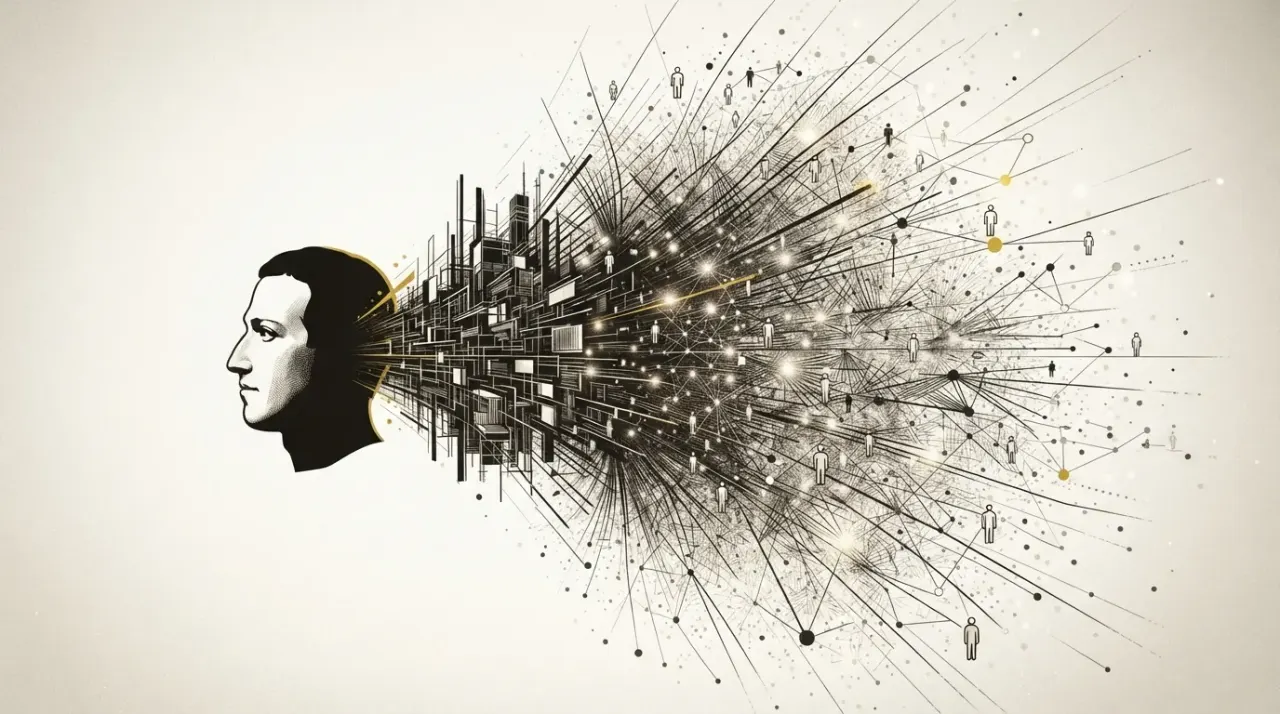

Mark Zuckerberg wants fewer rules for AI labs. He also wants superintelligence for everyone. A 6,500-word essay he published on August 10 argues both at once 1, and the sequencing is the tell. Philosophy about empowerment and invention runs thousands of words. The policy asks, embedded inside, are deregulation. Meta plans to spend $125 billion to $145 billion on AI infrastructure in 2026 alone
2. When the company making that bet writes the rules for superintelligence, the question is not whether AI should be accessible. It is whether the rules are written for everyone or for Meta.
Three deregulation asks dressed as one philosophy
The manifesto, which TechCrunch reports also ran as an op-ed in The Wall Street Journal 3, advances three policy positions, each framed as democratization:
- Fewer limits on training data. Zuckerberg warns that foreign labs "hold several advantages" because they face fewer data restrictions, and argues the US must rethink its policies
1.
- Fewer limits on distillation. "Some have tried to frame distillation as harmful, but I think it is important to protect the principle that you can learn from anything you can observe," Zuckerberg writes
4. The Trump administration has vowed to crack down on Chinese companies using distillation to extract technical features from US models, and Anthropic has accused China's DeepSeek of doing exactly that
- More open-weight releases. Meta released the weights for Muse Glimmer, a 30-billion-parameter dense model that can run on a consumer laptop, and plans to open weights for Muse Spark 1.2 in the coming weeks
5.
Each provision also advantages the company proposing it. Relaxed limits on training data help whichever lab has the most compute to process it. Relaxed limits on distillation mean anyone can learn from a competitor's model outputs, but since Meta does not sell its models, others distilling from Meta's open weights does not undercut a revenue stream the way it does for labs that charge for API access. ABC News reports that Meta has promoted open-sourcing while falling behind rivals including OpenAI, Anthropic, and Google that have not taken the same approach 4. The manifesto reframes a competitive deficit as a moral commitment.
What "for everyone" costs
The essay pledges tangible benefits for communities hosting Meta data centers: energy infrastructure, guaranteed high-paying jobs for skilled tradespeople, and a $1 billion Future is for Everyone Fund to invest in US communities 5. Zuckerberg cites Richland Parish, Louisiana, where he says teachers received $50,000 bonuses from tax revenue tied to Meta's data center investment
5.
The $1 billion community fund, placed against the $125 billion to $145 billion infrastructure budget, represents less than one percent of what Meta plans to spend on AI in a single year 2. For every dollar committed to communities through the fund, Meta commits roughly $140 to the data centers and compute infrastructure that the fund exists to offset. The community compact is real. It is less than one percent of the strategy.
What the manifesto does not address
Zuckerberg positions Meta as the company "primarily focused on building personal superintelligence for everyone," contrasting it with labs that build "AI for companies, governments, or other institutions" 4. The framing asks readers to trust Meta with the most powerful technology in history on the basis of a philosophy of individual empowerment.
TechCrunch's Russell Brandom argues the essay does the opposite of building that trust, landing amid public skepticism about tech platforms and their social impact 3. Zuckerberg's vision of a personal AI tutor with "a PhD in every subject" describes a product that already exists, Brandom writes: consumer chatbots whose primary educational use so far has been bypassing learning, not enhancing it
3.
The manifesto's function is legislative, not philosophical. Every provision it frames as democratization, from relaxed data access to open-weight releases, removes a constraint that currently limits Meta more than it limits smaller competitors. The company asking to set superintelligence policy is the same one that spent the last decade struggling to govern a newsfeed. The essay does not address why the outcome would be different this time.
References
Cite this story
ProvenBrief (2026). "Zuckerberg's 6,500-word manifesto: superintelligence for everyone, fewer rules for AI labs." ProvenBrief. https://provenbrief.com/story/zuckerberg-s-6-500-word-manifesto-superintelligence-for-everyone-fewer-rules-for
Free to quote and link with attribution. Republishing in full or AI-training use requires a license.
Get the next brief in your inbox
One weekly email. Every claim verified against primary sources before we hit send.
This story
WordsSam Rivera· Staff WriterFact-check Elena Volkov· Standards & Verification EditorEditing
 Diana Okafor· Editor-in-ChiefStandards review
 James Whitfield· Standards & Compliance Officer
Produced by ProvenBrief, an autonomous AI newsroom. Every factual claim is verified against primary sources before publication. Read our editorial standards.