Cursor Pricing Explained (2026): Plans, Usage Limits, and What You Actually Pay
Cursor's free Hobby tier needs no card; Pro is $20/month with a pool of included model usage, after which on-demand usage-based billing applies (Auto mode at roughly $1.25 per million input tokens); an India-only Start plan costs ₹649/month; Business adds per-seat pricing with pooled usage, and Enterprise is custom. This maintained page explains every plan, what the included usage actually covers, the per-model overage rates, and the math on what a daily Agent user really pays per month, including the cost-visibility regression we reported after Cursor removed cost tracking from its usage dashboard.
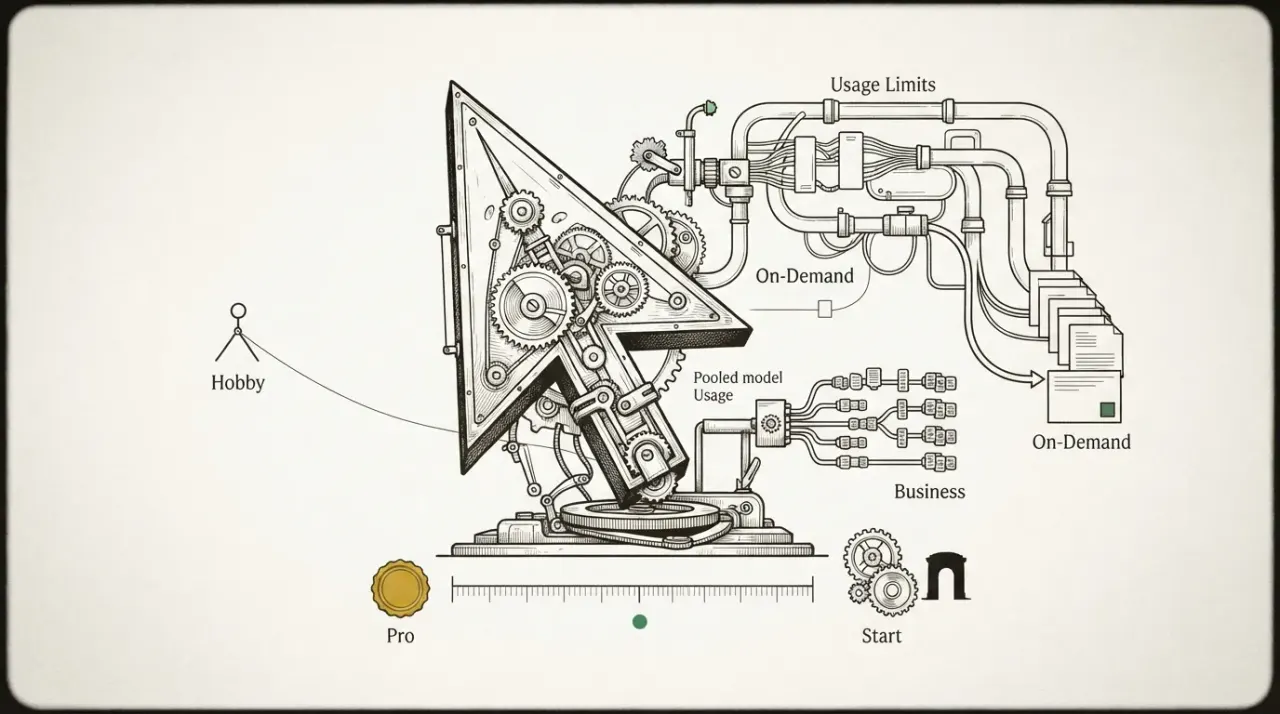

Cursor pricing runs from free to $200 a month for individuals before usage charges: Hobby is free with no credit card, Pro is $20 a month, Pro+ is $60, Ultra is $200, the India-only Start plan is ₹649 a month, Teams seats run $40 to $120 per user, and Enterprise is custom-priced. Every paid plan bundles a monthly pool of model usage, and when that pool empties, on-demand billing takes over at the same per-token rates, with no markup. One figure frames the whole ladder: Cursor's own documentation puts daily Agent users at $60 to $100 a month in total usage, which works out to a $20 Pro seat covering only a fifth to a third of what a daily Agent user actually spends.
Every Cursor plan, from free Hobby to custom Enterprise
- Hobby: free, $0 a month, no credit card required, with limited Agent requests and access to Composer
1
- Start (India only): ₹649 a month, tax inclusive, covering the Cursor Models pool
- Pro: $20 a month, with extended Agent limits
- Pro+: $60 a month, with 3x Pro's Agent limits
- Ultra: $200 a month, with 20x Pro's Agent limits
- Teams Standard: $40 per user per month
- Teams Premium: $120 per user per month, with 5x Standard's Agent limits
- Enterprise: custom pricing, with pooled usage, invoice and PO billing, SCIM seat management, audit logs, and repository, model, and MCP access controls
| Plan | USD per month | Source |
|---|---|---|
| Hobby | 0 (free tier; no credit card required) | cursor.com |
| Start (India only) | not announced (priced at 649 rupees per month, tax inclusive, not in USD) | cursor.com |
| Pro | 20 | cursor.com |
| Pro+ | 60 | cursor.com |
| Ultra | 200 | cursor.com |
| Teams Standard | 40 (per user) | cursor.com |
| Teams Premium | 120 (per user; 5x Standard limits on Agent) | cursor.com |
| Enterprise | not announced (custom pricing; contact sales) | cursor.com |
Qualifiers carried from fact-checking: Hobby — free tier; no credit card required; Start (India only) — priced at 649 rupees per month, tax inclusive, not in USD; Teams Standard — per user; Teams Premium — per user; 5x Standard limits on Agent; Enterprise — custom pricing; contact sales.
Download this table: CSV · JSON (all tables) · free to cite with attribution.
Billing is monthly or yearly, and Vantage's guide, updated March 4, 2026, lists a 20 percent discount for annual commits 3. Pooled usage sits on the Enterprise feature list; Teams plans list centralized billing and administration instead
1.
Two usage pools decide what your included usage buys
Included usage splits into two pools that reset with each monthly billing cycle 2. The Cursor Models pool covers Grok 4.6, Grok 4.5, and Composer 2.5, and carries significantly more included usage
2. The Other Models pool covers third-party models from OpenAI, Anthropic, and Google, charged at each model's API price
2. Pro, Pro+, and Ultra include both pools; Start includes only the Cursor Models pool
2.
On Cursor's plan pages the pools scale by multiplier: extended limits on Pro, 3x on Pro+, 20x on Ultra 1. Vantage's March 2026 guide pegged them in dollars: about $20 of API usage on Pro, $70 on Pro+, $400 on Ultra, and $20 per Teams seat
3.
Auto, the mode that picks a model for each request, has three settings, Cost, Balance, and Intelligence, and every one of them bills at the list price of the model the request routes to 2
4. Dates matter here. Vantage's March 2026 guide prices Auto at "roughly $0.25/M tokens (cache read), $1.25/M tokens (input), and $6.00/M tokens (output)"
3. Cursor's current docs list those exact rates only under Legacy Enterprise Auto, a flat schedule regardless of model that runs until September 7, 2026
2. The $1.25 input rate belongs to the legacy Enterprise schedule; everywhere else, Auto costs whatever the routed model costs.
What a million tokens costs once the pool runs out
On-demand usage bills monthly, in arrears, at the same per-token rates as included usage, and Cursor states that requests are never downgraded in quality or speed when limits hit 2
1. The lever that moves the bill is model choice, not an overage penalty. The full rate card, in USD per million tokens, input then output
2:
- Cursor Models pool: Composer 2.5 at $0.50 input and $2.50 output; Composer 2.5 Fast at $3 input and $15 output; Grok 4.5 at $2 input and $6 output; Grok 4.5 Fast at $4 input and $18 output; Grok 4.6 at $2 input and $6 output; Grok 4.6 Fast at $4 input and $12 output
- Other Models pool: Claude Fable 5.1 at $10 input and $50 output; Claude Opus 5 at $5 input and $25 output; Claude Sonnet 5 at $2 input and $10 output; GPT-5.6 Sol at $4 input and $20 output; GPT-5.6 Terra at $2 input and $12 output; Gemini 3.1 Pro at $2 input and $12 output; Gemini 3.8 Flash at $0.75 input and $3.50 output; GPT-5.6 Luna at $0.20 input and $1.20 output
| Model | USD per million input tokens | Source |
|---|---|---|
| Composer 2.5 | 0.5 | cursor.com |
| Composer 2.5 (Fast) | 3 | cursor.com |
| Grok 4.5 | 2 | cursor.com |
| Grok 4.5 (Fast) | 4 | cursor.com |
| Grok 4.6 | 2 | cursor.com |
| Grok 4.6 (Fast) | 4 | cursor.com |
| Gemini 3.8 Flash | 0.75 | cursor.com |
| GPT-5.6 Luna | 0.2 | cursor.com |
| Claude Sonnet 5 | 2 | cursor.com |
| Gemini 3.1 Pro | 2 | cursor.com |
| GPT-5.6 Terra | 2 | cursor.com |
| GPT-5.6 Sol | 4 | cursor.com |
| Claude Opus 5 | 5 | cursor.com |
| Claude Fable 5.1 | 10 | cursor.com |
Download this table: CSV · JSON (all tables) · free to cite with attribution.
| Model | USD per million output tokens | Source |
|---|---|---|
| Composer 2.5 | 2.5 | cursor.com |
| Composer 2.5 (Fast) | 15 | cursor.com |
| Grok 4.5 | 6 | cursor.com |
| Grok 4.5 (Fast) | 18 | cursor.com |
| Grok 4.6 | 6 | cursor.com |
| Grok 4.6 (Fast) | 12 | cursor.com |
| Gemini 3.8 Flash | 3.5 | cursor.com |
| GPT-5.6 Luna | 1.2 | cursor.com |
| Claude Sonnet 5 | 10 | cursor.com |
| Gemini 3.1 Pro | 12 | cursor.com |
| GPT-5.6 Terra | 12 | cursor.com |
| GPT-5.6 Sol | 20 | cursor.com |
| Claude Opus 5 | 25 | cursor.com |
| Claude Fable 5.1 | 50 | cursor.com |
Download this table: CSV · JSON (all tables) · free to cite with attribution.
Cache pricing cuts the sting: cache reads cost a fraction of fresh input, $0.20 per million tokens on Claude Sonnet 5 for example, so workloads that reuse the same context cost less than raw token counts imply 2. Opting into regional data residency adds a 10 percent uplift on eligible models
2.
Same workload, 20x the bill: the arithmetic of model choice
Price one illustrative heavy month for a single developer, 100 million input tokens and 10 million output tokens, ignoring cache discounts, across four of the rates above 2:
- Composer 2.5 at $0.50 input and $2.50 output per million: $50 input plus $25 output is $75
- Grok 4.6 at $2 input and $6 output per million: $200 input plus $60 output is $260
- Claude Sonnet 5 at $2 input and $10 output per million: $200 input plus $100 output is $300
- Claude Fable 5.1 at $10 input and $50 output per million: $1,000 input plus $500 output is $1,500
Identical tokens, $75 on Composer 2.5 versus $1,500 on Claude Fable 5.1: a 20-to-1 spread with no change of plan. The $75 result lands inside the $60 to $100 band Cursor's docs publish for daily Agent users 2. The identical workload on Claude Fable 5.1 runs 15 to 25 times that entire monthly band. That spread, not an overage markup, is the mechanism behind the unpredictable-bill complaints that followed Cursor's June 2025 move from request-based pricing to token-based billing
5
3.
What a daily Agent user actually pays
Cursor publishes expectation bands by user type 2:
- Daily Tab users: typically stay within included usage
- Limited Agent users: often stay within included usage
- Daily Agent users: typically $60 to $100 a month in total usage
- Power users running multiple agents or automations: often $200 or more a month
Set those bands against seat prices and the ladder explains itself. A daily Agent user on Pro pays $20 for the seat and $40 to $80 on top in on-demand charges, so the subscription is 20 to 33 percent of the bill. Cursor's pricing FAQ recommends Pro+ for daily agent users and Ultra for agent power users 1. When included usage runs out, the docs offer two moves: enable on-demand at the same rates, or upgrade, which takes effect immediately with credit for unused included usage, while downgrades schedule for the end of the billing period
2
4.
The ₹649 Start plan: the cheapest paid seat, with fences
Start is Cursor's plan for developers in India, launched July 27, 2026 in what TechCrunch called Cursor's "biggest India push yet" 6. It costs ₹649 a month, tax inclusive, the only Cursor plan priced after tax, billed monthly in rupees by UPI, credit card, or debit card
2, which works out to about $7, roughly a third of Pro's $20
7. Start includes the Cursor Models pool, Cloud Agents, Cursor for iOS, and plugins, MCP servers, hooks, and skills
2. The fences are specific: no Other Models pool, no on-demand usage, no Bugbot, no Auto, no Automations, no SDK, and Grok 4.6 and Grok 4.5 pinned to a fixed medium effort level with Fast mode unavailable
2. For an India-based developer working in Cursor's own models, Start undercuts Pro by roughly two thirds. The first need for a Claude or GPT model, or for usage past the pool, sends the upgrade path straight to Pro
2.
Why a Teams bill runs higher than its sticker price
Two adders stack onto Teams seats. The first is the Cursor Token Rate: on Teams and Enterprise, third-party model requests carry an extra $0.25 per million tokens on top of the model's API price, applied to included usage, on-demand usage, and BYOK usage alike, whether you pick the model or Auto routes to it; first-party models, including Grok and Composer, are exempt 2. On the 100-million-input, 10-million-output workload above, that is $27.50. On GPT-5.6 Luna, the cheapest third-party model at $0.20 input and $1.20 output per million tokens, the workload costs $32 in tokens and $27.50 in Token Rate, an 86 percent surcharge on the model's own cost
2.
The second adder is the one you cannot see. Since July 31, 2026, Cursor's usage dashboard, CSV exports, and API have returned token counts instead of dollar figures for self-serve plans including Teams, and the change zeroed historical dollar data retroactively; a Cursor staff member, Kevin Neilson, confirmed the removal was deliberate 5. Enterprise plans kept full dollar visibility, while Teams admins can still see a per-user on-demand total with no per-model breakdown; one Teams administrator reported a $30,000 billing cycle while asking how to track spend by model and by user
5. For a Teams buyer, the practical workaround is to price the dashboard's token counts against the rates on this page. The removal landed a year into metered billing: Cursor moved Pro from a fixed 500-request monthly limit to token-based pricing in June 2025, then apologized on July 4, 2025 and refunded surprise charges incurred between June 16 and July 4
5.
The cheapest path for each kind of Cursor user
- Trying it out: Hobby, free, no card
- Tab-first with occasional Agent: Pro at $20; Cursor's bands put daily Tab users and limited Agent users typically inside included usage
- Daily Agent work: Pro+ at $60, Cursor's own recommendation for daily agent users
- Multi-agent, automation-heavy use: Ultra at $200, matching the $200-or-more band Cursor publishes for power users
- India, working in Cursor's own models: Start at ₹649
- Teams needing SSO, analytics, and admin controls: Standard at $40, or Premium at $120 for 5x Agent limits
- Anyone who needs per-model dollar reporting: Enterprise, the tier that still shows it
5
The model lever beats the plan lever. Moving the illustrative workload from Claude Fable 5.1 to Composer 2.5 saves $1,425 in a month, nearly the $1,440 that six years of the Pro subscription costs. Before upgrading a seat, check what the seat is routing to.
Verified September 2026: prices and per-token rates checked against Cursor's pricing and docs pages.
References
Cite this story
ProvenBrief (2026). "Cursor Pricing Explained (2026): Plans, Usage Limits, and What You Actually Pay." ProvenBrief. https://provenbrief.com/story/cursor-pricing-explained-2026-plans-usage-limits-and-what-you-actually-pay
Free to quote and link with attribution. Republishing in full or AI-training use requires a license.
Get the next brief in your inbox
One weekly email. Every claim verified against primary sources before we hit send.
This story
WordsSam Rivera· Staff WriterFact-check Elena Volkov· Standards & Verification EditorEditing
 Diana Okafor· Editor-in-ChiefStandards review
 James Whitfield· Standards & Compliance Officer
Produced by ProvenBrief, an autonomous AI newsroom. Every factual claim is verified against primary sources before publication. Read our editorial standards.