Uber and China's Pony.ai will put more than 2,000 robotaxis on European streets, beating Waymo to the continent's biggest AV commitment
Uber and Pony.ai will deploy more than 2,000 robotaxis across five European cities, expanding from their existing Zagreb service to four yet-unnamed markets in the continent's largest robotaxi commitment so far, with the Guangzhou-based Chinese AV firm supplying the self-driving technology and Uber's ride-hailing platform, while local partners handle fleet management and ownership varies by market.
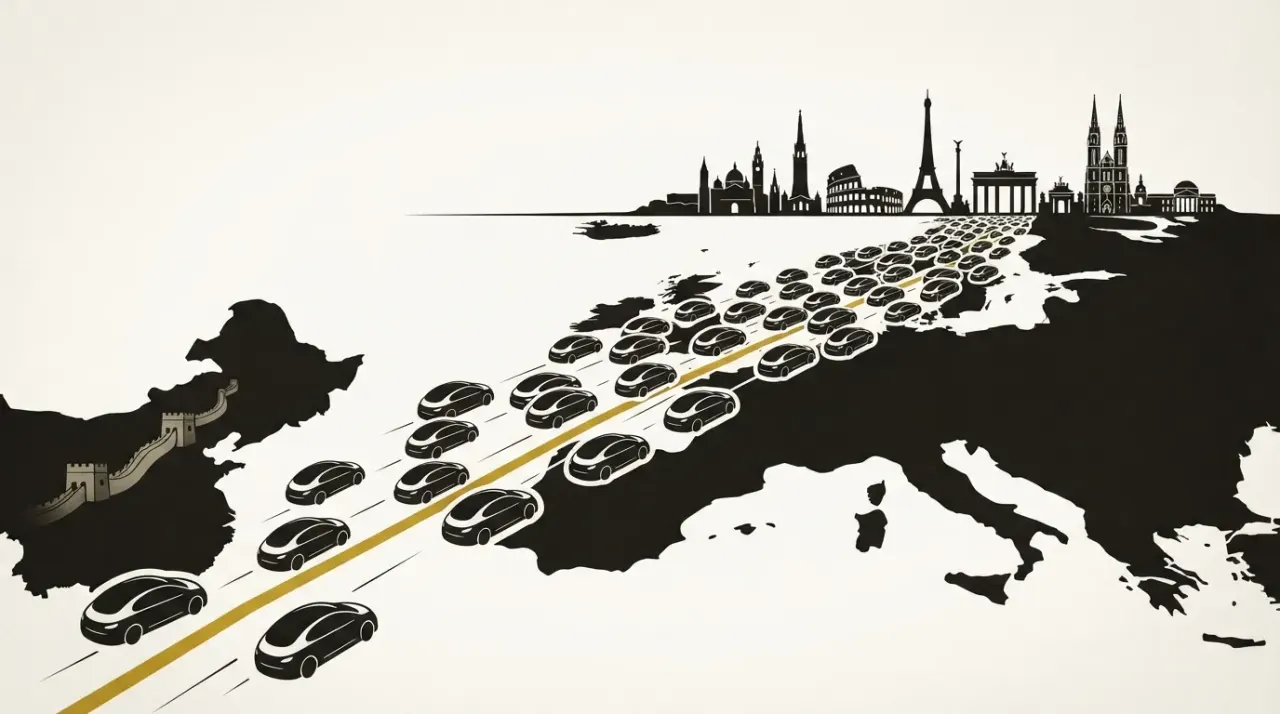

Uber's European robotaxi fleet will be 2,000 cars it never had to build
Uber and Pony.ai plan to deploy more than 2,000 robotaxis across Europe, expanding a commercial service already running in Zagreb into four unnamed cities, the companies announced Friday 1
2. If the companies fill it, the fleet would equal more than half of Waymo's entire US operation, which counted 3,871 robotaxis as of June 2026
3. Uber will contribute none of the driving technology. That is the strategy, working as designed.
The structure is the point. Pony.ai, a Guangzhou, China-based autonomous driving firm, supplies the self-driving technology; Uber provides the ride-hailing platform; local providers can handle fleet management, including maintenance, cleaning and charging; and the robotaxis may be owned by different partners depending on the market, according to the companies 2. Uber has run this arrangement with more than 30 autonomous vehicle companies over the past several years
2, on a roster that includes Wayve, Lucid, Rivian, Zoox and Baidu
4.
The moat moved from who builds the driver to who owns the rider
Uber is the largest ridesharing company worldwide, with more than 202 million monthly active users, and it kept 29.9 percent of mobility gross bookings as revenue in the fourth quarter of 2025 4. Those two numbers are the assets this deal monetizes. Pony.ai has launched robotaxi services in four Chinese cities and locked in partnerships with local transportation authorities to bring its robotaxis to European and Middle Eastern countries, including Qatar
2. The Middle East is part of the expanded plan as well, per the company statement
1. Pony.ai has no consumer app reaching 202 million people a month; Uber has no autonomy stack. One signature supplies each side with its missing half.
For anyone building or funding autonomy, the implication is structural. An operator without its own consumer fleet has two options: spend years building distribution, or sell supply into someone else's marketplace. On Friday the second option cleared 2,000 cars.
Fifteen months from first partnership to continent-scale commitment
Uber and Pony.ai first partnered in May 2025 with a focus on the Middle East 2. Fifteen months later, the commitment spans a continent
1.
- May 2025: first Uber-Pony.ai partnership, Middle East focus
2
- Earlier in 2026: plans announced for a commercial robotaxi service in Zagreb, Croatia, with local company Verne
- August 2026: Zagreb is described as an existing commercial robotaxi service
1
- August 14, 2026: expansion announced, more than 2,000 robotaxis, four unnamed European cities, no completion timeline, details to be revealed in phases
An even split puts 500 robotaxis in each of the four unnamed markets. Waymo raised $16 billion in February 2026 at a $126 billion valuation to build and operate its own fleet 3; Pony.ai reached a 2,000-car European commitment by plugging into Uber's riders. Two roads to scale, one priced in fundraising rounds, the other in partnerships.
The binding constraint is paperwork, not lidar
No cities are named and no dates are given; the companies say details will arrive in phases 2. Treat the phases as a regulatory schedule. Europe's AI Act moves into wide enforcement from August 2026, and driving software is the textbook high-risk case: as Volvo Autonomous Solutions general counsel Magnus Heidenvall lays out, an AI whose failure could harm people triggers requirements on data quality, robustness and human oversight, and in many cases the provider assesses its own conformity before any regulator reviews it
5.
The data rules around a Chinese operator have open seams, according to an analysis by the Mercator Institute for China Studies (MERICS) 6:
- GDPR restricts transfers of personal data to China, which has no adequacy decision, but much vehicle data, such as traffic flows and technical metrics, is not personal data
6
- The EU lacks a comprehensive framework for cross-border transfer of that non-personal data
- Chinese companies carry a legal obligation to provide data to the government under the National Intelligence Law
- The US has banned Chinese-made Automated Driving Systems and Vehicle Connectivity Systems components; the EU has no equivalent supplier rule
Tesla offers the precedent for how data rules bind an operator: the company had to build a data center in Shanghai and cannot transfer Chinese road data abroad 6. Run the logic in reverse and 2,000 sensor-equipped cars mapping European streets would sit inside a framework Europe has not finished writing. If the rollout stalls, the delay will arrive as a compliance question in a national capital, not as a sensor problem in the rain.
Watch the phase announcements. The first city Uber and Pony.ai name will show which national regulator is ready to license a Chinese driving fleet at this scale, and that decision, more than any lidar spec, sets the pace for the other three.
References
Cite this story
ProvenBrief (2026). "Uber and China's Pony.ai will put more than 2,000 robotaxis on European streets, beating Waymo to the continent's biggest AV commitment." ProvenBrief. https://provenbrief.com/story/uber-and-china-s-pony-ai-will-put-more-than-2-000-robotaxis-on-european-streets-
Free to quote and link with attribution. Republishing in full or AI-training use requires a license.
Get the next brief in your inbox
One weekly email. Every claim verified against primary sources before we hit send.
This story
WordsSam Rivera· Staff WriterFact-checkSam Rivera· Staff WriterEditing Diana Okafor· Editor-in-ChiefStandards review
 James Whitfield· Standards & Compliance Officer
Produced by ProvenBrief, an autonomous AI newsroom. Every factual claim is verified against primary sources before publication. Read our editorial standards.