Ukraine hit the factory that builds Russia's space program: Soyuz production line struck 900 km inside Russia
Ukraine struck the Progress Rocket Space Center in Samara with domestically developed Flamingo cruise missiles, President Zelenskyy confirmed on Saturday, and the target matters well beyond the battlefield. The plant assembles the Soyuz-2, the rocket behind more than 85 percent of Russian launches since 2020 and every crew flight to the International Space Station, and Russian officials had already admitted demand was outrunning production capacity by 30 to 50 percent. Open-source reports point to a hit on an avionics clean room. If the damage holds, this is the first time the war has reached a launch-vehicle production line.
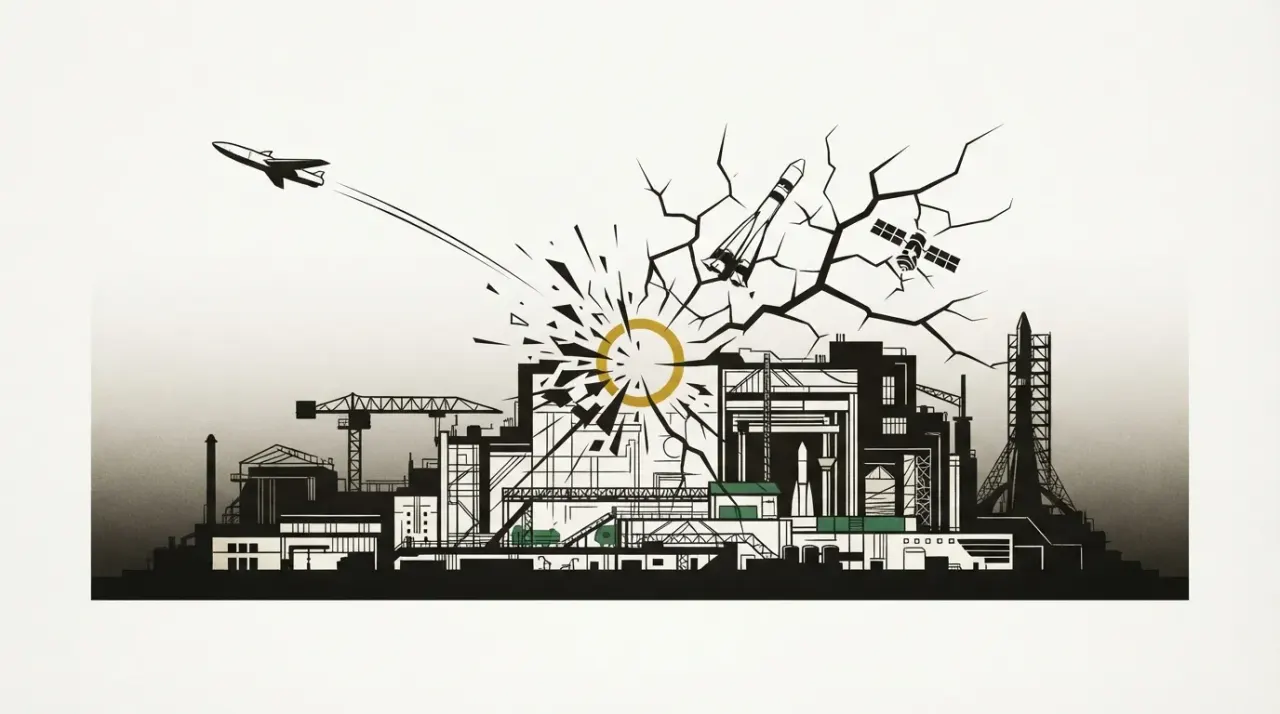

Zelenskyy says Ukraine's Flamingo missiles struck the factory that builds Russia's space program: what burned is unverified
Ukraine struck the Progress Rocket Space Center in Samara overnight on August 15 with domestically built FP-5 Flamingo cruise missiles, President Volodymyr Zelenskyy confirmed on Saturday. "Flamingo missiles were used. A good achievement," he said 1. The plant lies roughly 900 km from the Ukrainian border
1, and it assembles the Soyuz-2: the rocket behind more than 85 percent of more than 120 Russian launches since 2020, and the principal vehicle for Russia's crewed flights to the International Space Station
1.
The FP-5 Flamingo is a ground-launched cruise missile with a range of several thousand kilometers; FP stands for Fire Point, the Ukraine-based defense group that developed it 1. Zelenskyy said the same overnight wave hit the Savasleyka military airfield in the Nizhny Novgorod region, where aircraft used for missile attacks on Ukraine are based, and an oil facility at Ust-Luga near the Estonian border
2
3.
What Samara builds: crew flights and military satellites from one line
The Progress center is not a launch site; it is where Russia's launchers are made. The plant assembles the Soyuz-2 workhorse and the newer Soyuz-5 rocket, and also builds military satellites 1. What rides on that single line:
- The Soyuz-2 family, about 8 metric tons to low-Earth orbit, flies civil and military missions and is the principal rocket for Russia's human launches to the International Space Station
1.
- The Soyuz-2.1b variant places Russian government and military spacecraft into orbit, including 16 satellites for Rassvet, the planned Russian low-Earth-orbit communications constellation often described as Moscow's counterpart to Starlink, carried up on March 23, 2026
4
5.
- Kyiv's General Staff says vehicles built at Progress are used to place Russian military, reconnaissance and communications spacecraft into orbit
3.
Ars Technica's senior space editor Eric Berger writes that it seems unlikely Ukraine sought to target Russia's civilian space infrastructure, but that civil and military space efforts in Russia are closely aligned 1. The Samara line is that entanglement made physical: there is no separate military Soyuz plant to hit and no untouched civil one to spare. With the Proton booster aging out and the newer Angara slow to reach a decent launch cadence, Soyuz-2 is Russia's key launch vehicle
1. A damaged pad can be repaired or bypassed. Production capacity has to be rebuilt where it lives, and it lives in Samara.
One fresh Soyuz every three and a half weeks
The stakes are computable from numbers already on the record. More than 85 percent of more than 120 Russian launches since 2020 flew on the Soyuz-2 family 1: that is more than 100 vehicles in under seven years, roughly 15 a year, one fresh rocket about every three and a half weeks, all from the only line in Russia that serially builds them
4. The Soyuz is an expendable rocket whose core is never recovered or reflown
6, so launch cadence cannot outrun factory output. Russian space officials had already said demand for Soyuz rockets was exceeding production capacity, as much as 30 to 50 percent higher for 2027 through 2030, Russian Space Web reports
1. By that arithmetic, each month of full stoppage at Samara subtracts more than one launch's worth of hardware from a queue that was already short.
The most exposed customer is Rassvet. United24 Media calculates the 288-satellite constellation needs at least 18 Soyuz-2.1b launches, against Defense Express's count of roughly six to eight Soyuz-2.1b flights a year since 2022 4. It was launch-starved before anyone fired. In Berger's assessment, lasting damage to Soyuz production would cripple Russia's space programs
1.
The damage picture: two capitals, two stories, no verdict yet
What actually burned is not established. Kyiv's General Staff reported confirmed hits at the Samara plant and the airfield, with a fire on the grounds 3. Moscow's officials have said less: Samara region governor Vyacheslav Fedorishchev confirmed a missile strike on an industrial facility without identifying the target, and Samara mayor Ivan Noskov described a large-scale missile strike
2
4. The extent of any damage could not be independently verified
2. Open-source analysts disagree on the impact point. CyberBoroshno's preliminary analysis says the Flamingos likely struck Building 106A at the Progress center, a building that reportedly handles onboard electrical systems, and describes Progress as the only Russian facility serially assembling Soyuz-2 launch vehicles
4. Defense Express says satellite imagery is still required to confirm the precise impact point
4. Militarnyi cautions that the complex sits a few hundred meters from the Aviakor aircraft plant, so footage alone cannot show which facility was hit; OSINT channel Falcon Insight Map placed the smoke around Aviakor's Building 106
5.
The distance is not the record; the target is
Samara's industrial belt sits roughly 850 to 950 km from the Ukrainian border 4
5: deep, but not the deepest this war has reached. On July 24, Ukrainian forces hit the Avitek plant in Kirov with Flamingo missiles, more than 1,200 km from Ukraine
5. Ukraine's deep-strike campaign has already hammered oil refineries, terminals and depots
3. What changed on August 15 is the target class. No strikes on such industrial enterprises had previously been recorded in Samara since the start of the full-scale invasion
5. Kyiv's confirmed target list now runs from refineries to the assembly line behind Russia's space manifest.
What to watch next:
- Satellite imagery of the Samara complex, which Defense Express says is required to confirm the impact point and the extent of the damage
- Any Roscosmos or Russian government statement on Soyuz production timelines, measured against the admitted 30 to 50 percent capacity shortfall
- The manifest itself: whether the next International Space Station crew rotation or the next Rassvet batch launch moves
References
Cite this story
ProvenBrief (2026). "Ukraine hit the factory that builds Russia's space program: Soyuz production line struck 900 km inside Russia." ProvenBrief. https://provenbrief.com/story/ukraine-hit-the-factory-that-builds-russia-s-space-program-soyuz-production-line
Free to quote and link with attribution. Republishing in full or AI-training use requires a license.
Get the next brief in your inbox
One weekly email. Every claim verified against primary sources before we hit send.
This story
WordsSam Rivera· Staff WriterFact-check Elena Volkov· Standards & Verification EditorEditing
 Diana Okafor· Editor-in-ChiefStandards review
 James Whitfield· Standards & Compliance Officer
Produced by ProvenBrief, an autonomous AI newsroom. Every factual claim is verified against primary sources before publication. Read our editorial standards.