The AI Economy
06 pagesThe AI Economy pricing, plans and usage limits, with the billing terms and alternatives that matter before you pay. Every figure is sourced and re-checked against primary sources.
Turn the price into a decisionCompare this plan with another tool using your seats, bill and time value. Free calculator, no signup →01
The AI Model Lifespan Tracker: We Dated Every API Model Retirement at OpenAI, Google and Anthropic
The labs' own deprecation logs show API model lifespans are collapsing: Claude flagships released in 2025 lived just 12 to 13 months from launch to shutdown, down from 16 to 25 months for 2024 models, always on a fixed 60-day notice, while Google's preview-tier models die in as little as four months. We compile every dated model retirement across OpenAI, Google and Anthropic into one living tracker with median lifespan per lab, per tier, and the notice window enterprises actually get.
02
Codex vs Claude Code: Pricing, Limits, and Which Is Cheaper in 2026
Both ride subscriptions with hard usage caps: Codex comes bundled with ChatGPT plans ($20 Plus to $200 Pro) with weekly credit limits, its five-hour window has been suspended since 12 July 2026, while Claude Code ships with Claude Pro/Max plans whose five-hour rate limits Anthropic doubled in May 2026. On raw run cost, Codex's token-credit pricing ($125/M input, $750/M output on GPT-5.5) tends to bill less per task, while independent testing (Composio, Aug 2026) finds Claude Code finishes in about half the median time with fewer tool calls. The verdict splits by workload: Claude Code for interactive develop-test-iterate work, Codex for well-specified volume, GitHub integration, and cheaper throughput, with API-key bypass as the escape hatch on both when caps bite.
03
The AI publisher licensing ledger: 45 deals signed since 2023, and the lawsuits running in parallel
We compiled every disclosed content-licensing deal between a news publisher and an AI company since 2023 into a single structured dataset, counterparties, announcement date, content scope, duration, and financial terms where they exist, and the top-line finding is that the money is mostly invisible: only a small minority of signed deals carry any disclosed or reported value, while for some AI developers publisher lawsuits now outnumber the deals they have signed.
04
The Big Tech AI Revenue Split: Who Profits From AI Infrastructure vs AI Products
Our quarterly tracker compiles reported AI-related revenue across Microsoft, Google, Amazon, Meta, and Nvidia, then splits each company's figures into two categories: AI infrastructure (cloud hosting, GPU sales, API access that enables OTHER companies' AI) and AI products (Copilot, Gemini, Bedrock, proprietary tools). The data reveals that the AI economy is currently an arms dealer's market, with infrastructure revenue outpacing product revenue by a wide and widening margin across the board. We define an original metric, the AI Revenue Dependency Ratio: the share of each company's AI revenue derived from enabling other companies rather than selling its own AI products.
05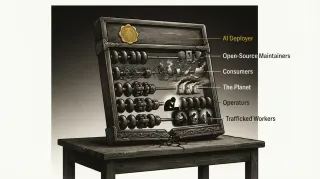
The Hidden Ledger: Why AI's Real Cost Is Always Billed to Someone Else
AI looks cheap because the deployer doesn't pay the real cost. Open-source maintainers pay in server crashes. Consumers pay in hijacked devices. The planet pays in gas plants. Operators pay in psychological collapse. Trafficked workers pay in their freedom. This isn't a side effect of AI, it's the business model. The near-zero marginal cost narrative is only true because the costs are externalized by design, and when the parties absorbing them push back or break down, the system's cost model collapses.
06
The Atoms Wall: Why AI's Real Limit Is Silicon, Electricity, and Concrete, Not Intelligence
AI's bottleneck has shifted from algorithms to physical infrastructure. Every frontier lab is now simultaneously a chipmaker, a power company, and a data center operator. This explainer shows why the next decade of AI progress will be gated by atoms, silicon, electricity, and cooling, not by intelligence, and why the companies that win will be the ones who solve physical supply chains, not the ones who write the cleverest training code.