The Hidden Ledger: Why AI's Real Cost Is Always Billed to Someone Else
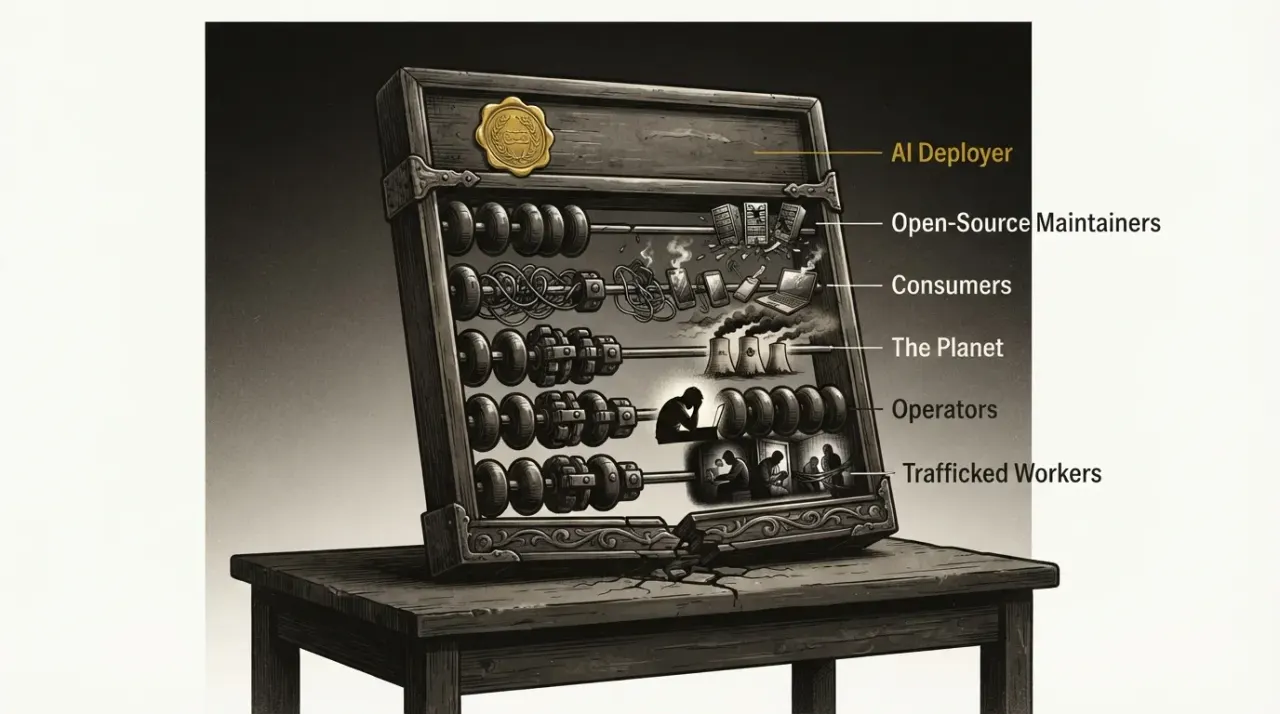
AI looks cheap because the deployer doesn't pay the real cost. Open-source maintainers pay in server crashes. Consumers pay in hijacked devices. The planet pays in gas plants. Operators pay in psychological collapse. Trafficked workers pay in their freedom. This isn't a side effect of AI, it's the business model. The near-zero marginal cost narrative is only true because the costs are externalized by design, and when the parties absorbing them push back or break down, the system's cost model collapses.

The Hidden Ledger: Why AI's Real Cost Is Always Billed to Someone Else
AI's near-zero marginal cost is only near-zero because someone else is paying the bill. The deployer captures the benefit. The cost is billed to a volunteer sysadmin, a television owner, a power grid, a military operator, or an enslaved worker who never consented and has no way to refuse. This is not a side effect of AI. It is the structural precondition for the cheap-AI narrative. Remove externalization and the cost model collapses.
Every claim that AI is nearly free carries an invisible asterisk: free for the operator, paid for by everyone else. Five independent cases, each documented in separate reporting, show the same mechanism operating across five different categories of cost.
This is a different argument from the claim that AI faces hard physical resource limits. The resources are not running out. They are being consumed by the wrong party. It is also different from the observation that verifying AI output costs more than generating it. The generation cost itself was never as low as advertised, because part of it was billed elsewhere.
The five ledgers nobody balances
Infrastructure billed to volunteers. Gentoo Linux, a volunteer-run open-source project, took its public Bugzilla bug tracker offline after AI scrapers flooded the system using thousands of rotating IP addresses. The scrapers ignored Gentoo's robots.txt file, which had already banned AI bots. Gentoo maintainer Michał Górny stated he was not a sysadmin and did not have time to fight the scrapers. AI companies needed training data and scraping access. Gentoo paid in server downtime and lost developer hours 1
2
3.
Compute billed to consumer devices. Samsung removed smart TV apps embedded with residential proxy software from Bright Data after security research revealed the apps turned always-on televisions into relay nodes for AI data scraping. The SDK's configuration permitted up to 200 GB of Wi-Fi traffic per month per device. Samsung said it was implementing platform-wide policies explicitly banning residential proxy SDKs. TV owners bought a television. They became infrastructure for a data pipeline they had never heard of 4
5.
Carbon billed to the atmosphere. The International Energy Agency projects data-center electricity consumption will more than double by 2030, reaching 945 terawatt-hours, equivalent to Japan's current demand. Google, Meta, and Microsoft have all reported emissions spikes in recent years despite net-zero commitments. Utilities are building new gas plants to serve data-center loads and deferring their own decarbonization timelines. Executives at those utilities insist the gas plants will not prevent reaching 2050 climate goals. Others are less certain 6
7
8.
Psychological collapse billed to operators. As many as five suicides occurred over a single month among personnel at US Cyber Command and associated cyber operations forces, as reported by Bloomberg. The CYBERCOM commander had identified cognitive and psychological sustainment for high-tempo cyber operators as his second-highest unfunded priority, estimated at $11 million. That figure equals 0.275% of the command's annual budget of more than $4 billion. For comparison, US Special Operations Command invests close to $80 million annually in human resilience for its forces. The acceleration AI brought to cyber operations was absorbed as stress and death by the humans operating the systems 9.
Freedom billed to trafficked workers. OpenAI disclosed that it disrupted a network of ChatGPT accounts operating from Cambodia near Poipet, a city linked to scam compounds. The accounts generated and translated scam scripts, created fake documents, and managed day-to-day operations of the syndicate. OpenAI's own data showed users maintaining records of employee debts, salary deductions, disciplinary fines, and discussions of escape attempts by trafficked workers. AI made the scam operation more efficient. The efficiency was extracted from enslaved people managed through a chatbot 10.
Why the accountability chain is invisible
Traditional externality problems have a polluter you can identify, regulate, and sue. A factory dumps chemicals in a river. You find the factory. AI's externalization is harder to see because the cost-shifter and the cost-bearer often do not know each other exist.
Gentoo does not know which AI company's scraper crashed its tracker. The requests came from thousands of rotating IPs with no identifying headers. Samsung TV owners do not know which AI pipeline used their bandwidth. The proxy SDK obscures the origin and destination of the traffic it carries. A Cyber Command operator processing AI-accelerated intelligence feeds cannot attribute their burnout to a specific model deployment. The accountability chain is so fragmented that the cost-bearer cannot identify the cost-shifter, let alone demand payment.
This fragmentation is a feature of distributed systems. When a model is trained on data scraped from thousands of sources, routed through millions of consumer devices, powered by electricity from dozens of utilities, and operated by personnel inside classified military commands, no single node bears enough of the cost to have standing to object.
What breaks when the cost-bearer resists
Each case contains a moment where the party absorbing the cost pushed back or failed:
- Gentoo took Bugzilla offline entirely. The volunteer project chose to lose access to its own tool rather than continue paying the bandwidth cost of scrapers it could not stop
1.
- Samsung recalled the apps and banned residential proxy SDKs platform-wide. The intervention came after independent security research exposed the practice, not after the company detected it internally
4.
- Utilities building new gas plants for data centers defer their own decarbonization timelines, transferring the carbon cost to everyone who breathes
8.
- Cyber Command operators collapsed. The cost-bearer did not resist. The cost-bearer broke
9.
- Trafficked workers in Cambodia's scam compounds remained captive. OpenAI banned the accounts. It did not free the people
10.
Each resistance point reveals the true cost that the zero-marginal-cost narrative had been hiding. If AI companies had to compensate Gentoo for infrastructure, reimburse Samsung TV owners for bandwidth, pay carbon prices reflecting actual atmospheric impact, fund the mental health systems their acceleration destroyed, and bear the human cost of trafficking their tools enable, the per-query economics would look nothing like the numbers in a pitch deck.
The costs are documented, measurable, and accumulating. The question is how long the system can keep billing them to someone else before the bill becomes impossible to ignore.
References
Cite this story
ProvenBrief (2026). "The Hidden Ledger: Why AI's Real Cost Is Always Billed to Someone Else." ProvenBrief. https://provenbrief.com/story/the-hidden-ledger-why-ai-s-real-cost-is-always-billed-to-someone-else
Free to quote and link with attribution. Republishing in full or AI-training use requires a license.
Get the next brief in your inbox
One weekly email. Every claim verified against primary sources before we hit send.
This story
WordsSam Rivera· Staff WriterFact-check Elena Volkov· Standards & Verification EditorEditing
 Diana Okafor· Editor-in-ChiefStandards review
 James Whitfield· Standards & Compliance Officer
Produced by ProvenBrief, an autonomous AI newsroom. Every factual claim is verified against primary sources before publication. Read our editorial standards.