Apple doubles inventory to $11 billion as AI-driven memory shortage forces Cook to abandon his famous lean supply chain
Apple reported its strongest June quarter ever, with iPhone sales up 22 percent and Mac sales up 29 percent year over year, but outgoing CEO Tim Cook warned that the AI boom is creating a memory supply crisis he called a hundred-year flood on pricing. Apple has stockpiled $11.1 billion in inventory, nearly double the $5.7 billion reported last September, abandoning the lean supply chain strategy Cook built his reputation on. The company has already raised Mac and iPad prices and predicts revenue growth will slow from 16 percent to between 9 and 11 percent as the AI industry's demand for advanced memory chips spills over into consumer electronics.
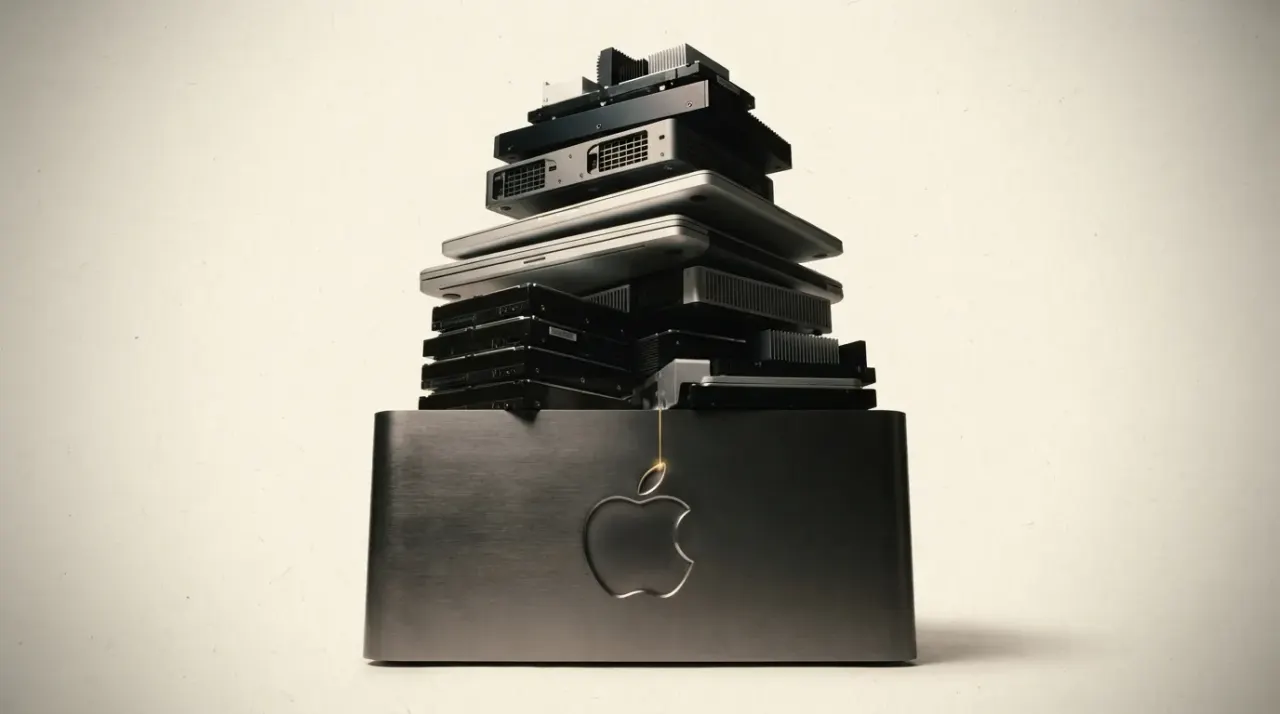

Apple nearly doubles inventory to $11 billion as AI-driven memory shortage reshapes its supply chain
Apple has stockpiled $11.1 billion in inventory, nearly double the $5.7 billion it held last September, a build-up that breaks from the lean supply chain strategy outgoing CEO Tim Cook built his reputation on. On Apple's earnings call Thursday, Cook described the AI industry's demand for advanced memory chips as a "hundred-year flood" on pricing 1. The stockpiling, combined with Cook's language, marks the point where the AI boom stopped being a data-center story and began reshaping what consumers pay for devices.
Record results collide with a supply squeeze
The shift arrives during Apple's strongest June quarter on record. The company says it posted $109.4 billion in revenue, up 16 percent year over year 2. iPhone sales grew 22 percent and Mac sales grew 29 percent compared to the same quarter a year ago, both exceeding expectations
1. But the record quarter collides with a supply problem that has nothing to do with consumer demand. The high-performance memory Apple needs for its custom A-Series and M-Series chips is the same class of component that generative AI companies are consuming at enormous scale, and the resulting shortage, known in the industry as "RAMageddon," is concentrated in exactly the parts Apple depends on most
1.
Cook told investors that the constraints would intensify through the coming quarter and that Apple would essentially be scrambling on the supply side 1. Apple has already raised prices on Macs and iPads, a move Cook characterized as reluctant. For the current quarter, Apple is guiding revenue growth of 9 to 11 percent year over year, down from the roughly 16 percent it has sustained across recent quarters. Apple's stock dropped 6 percent in after-hours trading following the call
1.
Why Apple's problem is everyone's problem
Apple commands more purchasing power and supplier leverage than nearly any consumer electronics company on earth. It buys memory at volumes that secure preferential allocation and pricing that smaller competitors cannot match. If Apple is hoarding $11 billion in parts and warning of a "hundred-year flood" on memory pricing, the cost pressure on every other hardware maker is worse, not better. Apple can absorb higher component costs and still deliver record quarters and double-digit growth. A mid-tier laptop brand or a budget phone maker without Apple's cash reserves faces the same rising memory prices with a fraction of the negotiating leverage and no inventory cushion to bridge the gap. The margin protection that carried hardware companies through previous component shortages, when they could wait out a temporary spike, does not apply when the largest buyer in the market is pre-purchasing months of supply.
The timing compounds the exposure. When Senior VP of Hardware Engineering John Ternus takes over as CEO in September, he inherits a supply chain operating under constraints Cook never had to navigate at this scale 1. Cook's approach to inventory, keeping levels low to reduce storage costs and minimize the risk of holding obsolete components, produced Apple's margin dominance for over a decade. Nearly doubling stock to $11.1 billion signals that guaranteed access to parts has become more valuable than the efficiency of running lean. Whether that is a temporary hedge or a permanent recalibration, Cook did not say. What he did signal is that the operator who defined modern supply chain management has concluded his playbook no longer fits the conditions he is facing.
Cite this story
ProvenBrief (2026). "Apple doubles inventory to $11 billion as AI-driven memory shortage forces Cook to abandon his famous lean supply chain." ProvenBrief. https://provenbrief.com/story/apple-doubles-inventory-to-11-billion-as-ai-driven-memory-shortage-forces-cook-t
Free to quote and link with attribution. Republishing in full or AI-training use requires a license.
Get the next brief in your inbox
One weekly email. Every claim verified against primary sources before we hit send.
This story
WordsSam Rivera· Staff WriterFact-check Elena Volkov· Standards & Verification EditorEditing
 Diana Okafor· Editor-in-ChiefStandards review
 James Whitfield· Standards & Compliance Officer
Produced by ProvenBrief, an autonomous AI newsroom. Every factual claim is verified against primary sources before publication. Read our editorial standards.